








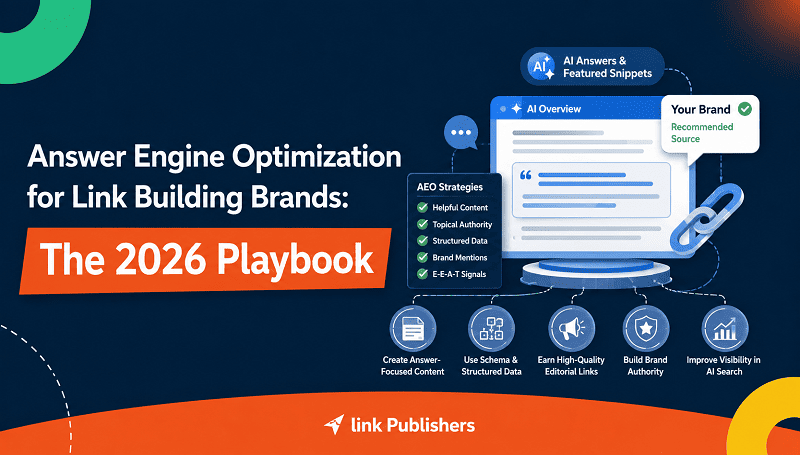
Answer Engine Optimization for Link Building Brands: The 2026 Playbook

Explore this post with:
Answer Engine Optimization is the practice of structuring your content so that it is cited as a source on AI platforms like:
- Google AI Overviews
- ChatGPT
- Perplexity
- Claude
- And more
Where traditional SEO earns you a spot on a ranked list, answer engine optimization makes your brand the answer itself. In 2026, that difference decides who gets discovered and who disappears.
The shift is already here. AI Overviews now appear in 71.68% of personalized Google searches in the United States. When they appear, they push traditional organic results further down the page. Hence, it becomes harder to earn clicks.
People are increasingly getting answers without visiting a website, changing how brands need to earn visibility.
AEO is not just an on-page exercise. The signals AI models use to decide who to cite are heavily off-site, built from earned links, brand mentions, and digital PR. That is exactly where a link building brand has an advantage.
This guide covers what AEO is and how it differs from GEO and SEO. You will also learn how link building powers the whole system.
What Is Answer Engine Optimization?
Answer engine optimization (AEO) is the process of structuring content so that AI-powered answer engines can extract and cite it when generating responses. Instead of competing for a blue link, you compete to become the source an AI names when it answers a question.
Traditional search returns a list of links for the user to explore. Answer engines work differently. They synthesize a single response from multiple sources, then cite the ones they trust most. Your aim shifts from ranking a page to earning a citation inside the answer.
This matters because search behavior has fundamentally changed. Users now ask ChatGPT for recommendations and turn to Perplexity for research. Google answers many queries directly through AI Overviews before a user clicks anything. If your brand is not cited in those answers, you are invisible to a growing share of your market.
What Is an Answer Engine?
An answer engine is any system that delivers direct answers instead of a list of links. Some are built into traditional search, while others are standalone AI platforms.
The major answer engines in 2026 include:
- Google AI Overviews — AI-generated answers at the top of Google results
- ChatGPT Search — OpenAI’s search-enabled assistant with inline citations
- Perplexity — an AI answer engine built around cited sources
- Google Gemini — Google’s conversational AI with search grounding
- Microsoft Copilot — Bing-powered AI search with source links
Most of these engines rely on retrieval-augmented generation (RAG). The system retrieves relevant content from the web, then synthesizes an answer and cites its sources. Understanding this pipeline is the key to getting cited, and we break it down further below.
Why AEO Matters Now
AEO matters now because AI answers are absorbing the traffic that used to flow to websites. The data makes the urgency clear.
| Signal | 2026 Data |
| AI Overview presence | 71.68% of all Google searches |
| Informational queries with AI Overviews | Nearly 99.9% |
| CTR drop when AI Overview appears | 58% for the top results |
| US searches ending without a click | 68% |
| Enterprise GenAI adoption by end of 2026 | 80%+ forecast |
The takeaway is simple. Ranking number one means less when an AI answer sits above you and satisfies the query first. AI search optimization is no longer optional for brands that want to stay visible.
AEO vs GEO vs SEO vs AIO: Clearing Up the Acronyms
The terms AEO, GEO, SEO, and AIO get used interchangeably, but they mean different things. Here is the cleanest way to separate them.
| Discipline | Goal | Where It Shows | Primary Signals | Key KPI |
| SEO | Rank your page in results | Google, Bing SERPs | Backlinks, content, technical health | Rankings, organic traffic |
| AEO | Get cited as the answer | Featured snippets, AI answers | Structure, schema, clarity | Citation frequency |
| GEO | Get recommended by generative AI | ChatGPT, Perplexity, Gemini | Brand mentions, authority, freshness | Share of AI voice |
| AIO | Optimize for all AI interfaces | Every AI surface | Combined on-site and off-site | AI visibility overall |
The overlap is real, but the focus differs. SEO gets you onto a ranked list. AEO gets your content pulled directly into an answer. GEO makes generative engines recommend your brand across conversations. AIO is the umbrella term some use for all of it.
What Is Generative Engine Optimization (GEO)?
Generative engine optimization (GEO) is the practice of optimizing content and brand signals so that generative AI engines recommend you when generating answers. It is broader than AEO, covering everything from content structure to the off-site authority that shapes how AI perceives your brand.
Most experts treat AEO as a subset of generative engine optimization. AEO focuses sharply on the citation and attribution layer, while GEO covers the wider goal of being recommended across AI-generated responses. In practice, you should hire generative engine optimization services to work on both together.
The One-Line Mental Model
Here is the framing worth remembering: SEO ranks you, AEO makes you the answer, and GEO makes AI recommend you.
Keep that distinction in mind, and the tactics fall into place. Every technique in this guide maps back to one of those three goals. The strongest strategies serve all three at once.
How Answer Engines Choose What to Cite
Answer engines choose sources through a multi-step pipeline that filters, ranks, and selects content to cite. Understanding this process is the foundation of AI citation optimization, since it reveals exactly where you can influence the outcome.
The pipeline generally works in four stages:
- Crawl and index — the engine gathers content from the web and its training data
- Build a candidate set — for a given query, it retrieves the most relevant sources
- Synthesize — the model generates an answer by combining information from those sources
- Cite — it attributes specific claims to the sources it trusts most
The critical insight is that AI engines cite passages, not whole pages. A single well-structured paragraph that answers a question directly is far more likely to be lifted than a dense wall of text. This is why structure matters more than style in AEO.
Off-site signals shape which sources make the candidate set in the first place. If trusted sites across the web mention and link to your brand, AI systems are more likely to see you as authoritative. This is the bridge between link building and AEO, and it is where the real opportunity lives. For the foundational relationship, see how backlinks and AI work together.
The Princeton GEO Study Findings
The most rigorous evidence on AEO comes from the Princeton GEO study, published at the KDD 2024 conference by researchers from Princeton, Georgia Tech, IIT Delhi, and the Allen Institute for AI. The team tested nine content techniques across roughly 10,000 queries to determine which actually increase AI citation rates.
| Technique | Citation Lift | What It Means |
| Citing sources | Up to +115% | Referencing credible sources delivers the biggest gains, especially for lower-ranked pages |
| Quotation addition | Up to +100% | Direct quotes from named sources signal authority and boost citations |
| Statistics addition | Up to +98% | Specific numbers get extracted and cited directly |
| Fluency optimization | Modest, steady gains | Clean, readable writing helps citations across most positions |
| Authoritative voice | Mixed, position-dependent | Authority framing helps some ranks, hurts others |
The largest gains are seen for lower-ranked content (rank-5), where citing sources, quotes, and statistics serve as strong equalizers. Higher-ranked pages experience smaller or, occasionally, negative effects, since they already earn citations.
The lesson is direct. Content packed with specific data, real quotes, and clear source attribution wins citations. Two techniques actively hurt visibility in the study: keyword stuffing and excessive meta-tag manipulation. In the AI era, credibility signals beat old-school tricks every time.
How Link Building Powers AEO
This is where a link building brand pulls ahead of many generic AEO tactics. Earned links, brand mentions, and digital PR feed the off-site trust signals that AI models weigh when deciding who to cite. On-page structure gets you eligible, but off-site authority gets you chosen.
The data here is striking. Ahrefs studied 75,000 brands across ChatGPT, AI Mode, and AI Overviews to find what correlates with AI visibility. Branded web mentions correlated at 0.664, roughly three times stronger than backlinks alone at 0.218.
That single finding reframes the entire strategy. If AI visibility depends on earned mentions and third-party authority, then link building and digital PR are not side tactics. They are the core engine of AI search visibility. Here is how the pieces connect:
- Earned links build the domain authority that helps you enter candidate sets
- Brand mentions create the entity signals AI uses to trust and recognize you
- Digital PR lands you in the “best of” roundups AI aggregates for recommendations
- Consistent citations across the web reinforce your authority on a topic
For the full evidence base connecting links to AI ranking, see our guide on backlinks for AI search ranking.
Brand Mentions and Entity Authority
Brand mentions build AI trust even when they do not include a link. Entity signals now shape how both Google and AI systems understand who you are and what you are authoritative about.
Entity SEO focuses on how search engines recognize your brand as a distinct entity associated with specific topics. When trusted sites mention your brand alongside relevant subjects, you strengthen those connections. AI systems then treat you as a credible source worth citing on those topics.
Guest posts are one of the strongest ways to build these signals, as we explain in our breakdown of how guest posts influence AI models and strengthen brand trust signals.
Digital PR and the “Best Of” Lists
AI engines lean heavily on roundup content when making recommendations. When someone asks ChatGPT for the “best link building services,” the model often pulls from listicles and comparison articles across the web. Being featured in those lists directly shapes whether you get recommended.
Digital PR earns you placement in exactly these high-authority roundups and publications. A single well-placed feature can influence how AI describes your entire category. This is why digital PR services and guest posting services have become central to AI visibility, not just traditional SEO.
Niche Edits and Citations Into Ranking Pages
Niche edits place your brand and links inside content that AI engines already trust and cite. Because these pages are indexed and often rank well, your mention benefits from their established authority immediately.
The tactic works because AI frequently cites pages that already perform in traditional search. Getting your brand into those pages puts you inside the sources AI is likely to pull from. Professional niche edit services ensure these placements land on relevant, high-authority pages rather than random sites.
The AEO Framework: 8 Steps to Get Cited
If you want to know how to optimize for AI search, follow these eight steps to structure content that AI engines extract, trust, and cite. Each one is grounded in the research covered above.
1. Lead With a 40 to 60 Word Direct Answer
The single highest-impact tactic is answering the question immediately. Open each section with a concise, self-contained answer of 40 to 60 words. AI engines lift these passages directly into their responses.
| Weak Opening | Strong Opening |
| “There are many factors to consider when thinking about link building and how it might affect your visibility…” | “Link building affects AI visibility by building the brand mentions and authority signals AI models use to choose sources. Branded mentions correlate roughly 3x stronger than backlinks with AI citations.” |
The strong version is specific, factual, and extractable. It reads well on its own, which is exactly what an answer engine needs.
2. Use Question-Based Headings
Structure your headings as the questions your audience actually asks. This matches the natural-language queries people type into answer engines. A heading like “How does link building help AI search?” aligns directly with real prompts, making your content easier to match and cite.
3. Add Schema Markup
Schema gives AI engines machine-readable labels for your content. FAQPage, Article, and Organization schema all help engines understand and extract your information. Research shows sites using structured data and FAQ blocks saw a 44% increase in AI search citations.
Here is a simple FAQPage JSON-LD block you can adapt:
{
“@context”: “https://schema.org”,
“@type”: “FAQPage”,
“mainEntity”: [{
“@type”: “Question”,
“name”: “What is answer engine optimization?”,
“acceptedAnswer”: {
“@type”: “Answer”,
“text”: “Answer engine optimization is the practice of structuring content so AI platforms cite it as a source when generating answers.”
} }] }
4. Structure for Scanning
Chunkable content wins citations. Use short paragraphs, bulleted lists, and tables to make each point independently extractable. Semantic triples (subject-predicate-object statements, such as “Link Publishers offers guest posting services”) give AI clear, factual units to work with. Dense, meandering prose resists extraction and gets skipped.
5. Build Topical Depth and Clusters
Cover your topic completely rather than superficially. AI engines favor comprehensive resources over thin pages, and they often cite the single most thorough source on a subject. Build content clusters in which a pillar page links to supporting articles, signalling deep topical authority to both Google and AI systems.
6. Earn Links, Mentions, and Citations
This step reconnects to the wedge. On-page work makes you eligible, but earned authority makes you chosen. Build backlinks, brand mentions, and citations from trusted sites across your niche. This is the off-site foundation that determines whether AI includes you in its candidate set. Scalable link building services make this repeatable rather than random.
7. Keep Content Fresh
Freshness drives citations. AirOps research found that 83% of AI citations for commercial queries came from pages updated within the past 12 months, with over 60% refreshed in the last six months. Set a quarterly cadence to update key pages with new data, examples, and insights.
8. Show E-E-A-T Signals
Experience, expertise, authoritativeness, and trust all influence what AI cites. Add clear author bylines with credentials, cite credible sources, and include first-hand experience. Sites with author schema are three times more likely to appear in AI answers. These trust signals tell both Google and AI systems that your content is credible.
Quick AEO Checklist:
- [ ] Every section opens with a 40 to 60-word direct answer
- [ ] Headings phrased as real questions
- [ ] FAQPage, Article, and Organization schema in place
- [ ] Content structured with lists, tables, and short paragraphs
- [ ] Topic covered comprehensively in a cluster
- [ ] Backlinks and brand mentions actively earned
- [ ] Key pages refreshed quarterly
- [ ] Author credentials and sources clearly shown
Platform-by-Platform: How to Get Cited on Each Engine
Each answer engine favors different signals. Here is how to optimize for the major platforms, since a one-size-fits-all approach leaves citations on the table.
| Platform | What It Favors | Top Tactic |
| Google AI Overviews | Top-10 ranking pages, strong SEO | Rank well, then add an answer-first structure |
| ChatGPT Search | Brand presence, third-party mentions | Build earned mentions across the web |
| Perplexity | Freshness, authority, clear citations | Keep content current and well-sourced |
| Gemini | Multimodal content, Google grounding | Strong SEO plus structured data |
| Copilot | LinkedIn and B2B authority signals | Build B2B brand presence |
Google AI Overviews
Google AI Overviews pull heavily from pages that already rank in the top 10. Research shows 76.1% of URLs cited in AI Overviews also rank in Google’s top 10 results. This means strong traditional SEO remains your foundation. Effective AI Overviews optimization means ranking well first, then adding answer-first structure and schema to increase your citation odds.
ChatGPT Search
Learning how to rank in ChatGPT starts with one fact: it cites differently. It often pulls lower-ranking pages when they provide relevant, contextual information. It leans heavily on brand presence and third-party mentions rather than pure rankings. To get cited, focus on building your brand’s footprint across trusted sites through digital PR and guest posting.
Perplexity
Perplexity prioritizes freshness, authority, and clear source citations. It shows the strongest proximity to traditional rankings among the AI engines, with about 60% overlap with Google’s top results. Keep your content updated, well-sourced, and authoritative to earn Perplexity citations.
Gemini and Copilot
Gemini benefits from Google’s search grounding and rewards multimodal content plus structured data. Copilot draws on Bing and leans toward B2B and LinkedIn authority signals, making it valuable for business-focused brands. Both reward the same core fundamentals: strong content, clear structure, and earned authority.
Best Answer Engine Optimization Tools in 2026
The right tools help you track and improve AI visibility. Here are the categories and options worth knowing, kept honest and useful.
| Tool | Category | What It Does | Free Tier |
| Ahrefs Brand Radar | Tracking | Monitors brand mentions across AI platforms | No |
| Semrush AI toolkit | Tracking | Tracks AI visibility and citations | Limited |
| Google Search Console | Measurement | Shows AI-driven impressions and queries | Yes |
| GA4 | Measurement | Tracks AI referral traffic by source | Yes |
| Schema markup validators | Optimization | Tests structured data | Yes |
| SparkToro | Research | Audience and mention research | Limited |
Start with the free tools before investing in paid platforms. Google Search Console and GA4 cover the fundamentals of measuring AI visibility. You can also verify your link health with our free dofollow and nofollow link checker as part of your AEO groundwork.
How to Measure AI Search Visibility
Measuring AI search visibility requires tracking citations, referrals, and share of voice across platforms. Most standard SEO dashboards do not show this, so you need a deliberate approach.
Focus on these core metrics:
- AI referral traffic — visits from ChatGPT, Perplexity, Gemini, and Copilot
- Citation frequency — how often AI engines cite your brand or content
- Share of AI voice — your citation rate versus competitors in your category
- Assisted conversions — business outcomes influenced by AI visibility
To track AI referrals in GA4, create a custom channel group to isolate traffic from sources like chatgpt.com, perplexity.ai, and gemini.google.com. This separates AI-driven visits from general referral traffic for cleaner reporting. Google Search Console now surfaces some AI-driven impression data too, though its AI reporting is still expanding.
For the complete, step-by-step measurement workflow, our AI search analytics guide walks through the exact setup. Measurement is where most brands fall short, so this is worth getting right.
AEO for Agencies and White-Label Partners
Any AEO agency can package these services at a high value, and the demand is climbing fast. As clients realize their AI visibility is slipping, they need partners who can rebuild it. This is a natural extension of existing SEO and link building offerings.
The service bundles cleanly. Agencies combine content optimization, schema implementation, and the off-site authority work that AEO depends on. Because so much of AEO relies on earned links and brand mentions, a link building partner becomes essential to its delivery.
This is where a white-label model fits. Agencies can resell guest posting, digital PR, and niche edits under their own brand while a partner handles fulfillment.
Link Publishers supports exactly this through guest posting services and digital PR services, giving agencies the off-site engine that powers client AEO results without building an in-house outreach team.
Common AEO Mistakes to Avoid
Even solid strategies fail when these mistakes creep in. Avoid them to protect your AI visibility.
- Burying the answer — leading with fluff instead of a direct response means AI skips your content
- Skipping schema — without structured data, engines struggle to extract your information
- Thin content — shallow pages lose to comprehensive, authoritative resources
- Ignoring off-site signals — neglecting links and brand mentions leaves you out of candidate sets
- No freshness cadence — stale content gets cited far less than recently updated pages
- Keyword stuffing — the Princeton study proved this actively hurts AI visibility
The pattern is clear. These AEO best practices rewards clarity, structure, authority, and freshness. It punishes the manipulative tactics that stopped working years ago.
The Bottom Line: AEO Runs on Earned Authority
Answer engine optimization is the new frontier of search visibility, and it rewards brands that earn trust across the web. On-page structure makes you eligible for citation, but off-site authority decides whether AI actually chooses you. That authority comes from links, brand mentions, and digital PR.
The data proves it. Branded mentions outweigh backlinks by roughly three times for AI visibility, and the vast majority of AI citations come from earned media. This is why link building sits at the heart of any serious AEO strategy, not on the sidelines.
Start by structuring your content to answer questions directly, then build the earned authority that gets you cited. If you want to accelerate that off-site foundation, explore our link-building, digital PR, and guest posting services. In the AI search era, the brands that earn authority become the answer, and the answer is what everyone remembers.
FAQs
Answer engine optimization is the practice of structuring content so that AI platforms like ChatGPT, Perplexity, and Google AI Overviews can cite it as a source. It focuses on becoming the answer AI delivers, rather than just ranking on a list of links below the AI response.
SEO ranks your page in search results. AEO gets your content cited as the direct answer in AI responses. GEO, or generative engine optimization, is the broader practice of getting AI engines to recommend your brand. AEO is generally considered a subset of GEO.
Get cited by ChatGPT by building brand mentions across trusted third-party sites and structuring content with direct, extractable answers. ChatGPT relies heavily on earned mentions and often cites lower-ranking pages that provide clear, relevant, well-sourced information.
Yes. Link building builds the brand mentions and authority signals AI models use to choose sources. Ahrefs found that branded web mentions correlate with AI visibility roughly three times as strongly as backlinks alone.
Optimize for Google AI Overviews by ranking in the top 10 first, then adding an answer-first structure and schema. Additionally, strong traditional SEO also remains the foundation.
Rank on Perplexity by keeping content fresh, well-sourced, and authoritative. Perplexity prioritizes freshness and clear citations, and it shows the closest alignment to traditional Google rankings among the major AI engines.
FAQPage, Article, and Organization schema are the most valuable for AEO. Sites using structured data and FAQ blocks saw a 44% increase in AI search citations. Author schema also helps, making pages three times more likely to appear in AI answers.
No, SEO is not dead. Traditional rankings still feed AI Overviews, since 76.1% of cited URLs rank in Google’s top 10. SEO now works alongside AEO and GEO, with strong search fundamentals remaining the foundation for AI visibility.