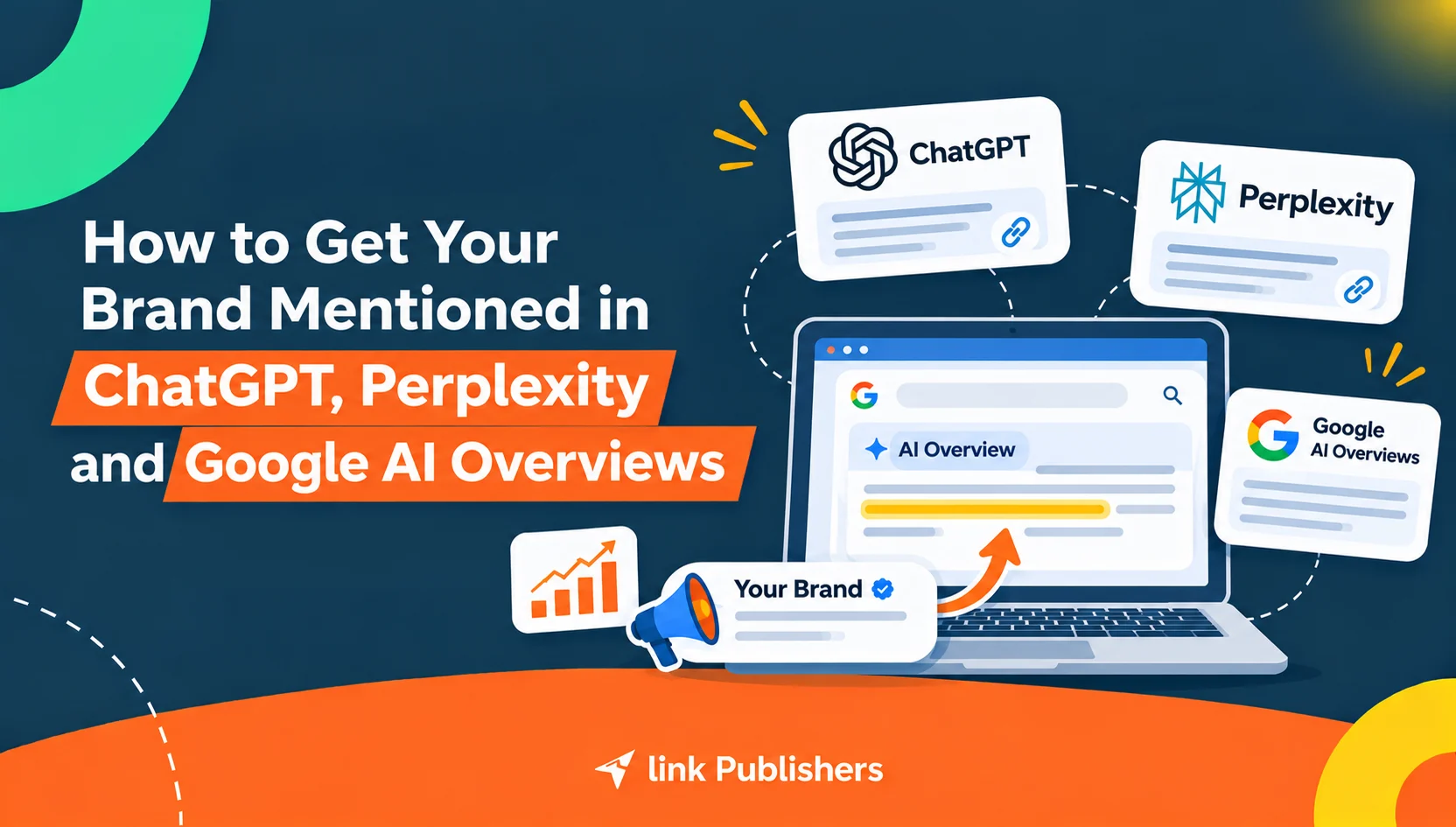
How to Get Your Brand Mentioned in ChatGPT, Perplexity and Google AI Overviews

Explore this post with:
AI assistants name the brands the web already talks about consistently. To get mentioned, you need three things working together:
- A site AI crawlers can actually read
- High-quality and original content they can quote
- Mentions on the sources these tools already cite
Do you think your business has all these criteria fulfilled? If you want to know how to get your brand mentioned in ChatGPT and other AI platforms, you are in the right place!
This guide breaks down exactly how to earn those mentions.
How ChatGPT, Perplexity and AI Overviews Decide Which Brands to Mention
These three platforms name brands through two different mechanisms. Understanding the split is the foundation for everything else.
Training Data vs Live Web Search
A model “knows” your brand in one of two ways.
The first is training data. It is a fixed snapshot of the web the model learned from during training. If your brand was mentioned widely across that data, the model recalls you even with no live search.
The second is live retrieval. This is when the platform searches the web in real time and pulls current sources into its answer.
Training data rewards long-term, consistent AI brand visibility across the web. On the other hand, live retrieval rewards being on the specific pages a platform pulls for a given prompt. You need both.
How Each Platform Finds Its Sources
Each platform crawls and cites differently, and this table reflects how they actually work in 2026:
| Platform | How it finds sources | Shows citations? |
| ChatGPT (Search) | Crawls with OAI-SearchBot; retrieves live results for current queries | Yes, inline links |
| Perplexity | Crawls with PerplexityBot; built around live retrieval | Yes, numbered sources |
| Google AI Overviews | Runs on Googlebot, drawing from the normal Search index | Yes, source links |
Note: Google-Extended does not control brand mentions in AI overviews. It is a control token for Gemini model training only, not a crawler. AI Overviews and AI Mode are part of Google Search and run on Googlebot. So, blocking Google-Extended does nothing to your AI Overview visibility. Google confirms this in its own crawler documentation.
The flow for all three looks like this:
Prompt → platform searches or recalls → sources selected → answer generated + brands named
Your job is to influence the “sources selected” stage. Let’s see how you can do that and get your answer to how to get your brand mentioned in ChatGPT and other AI platforms:
Step 1: Audit Where Your Brand Shows Up Today
You cannot improve what you have not measured. Before any AI or Generative Engine Optimization, establish a baseline of where your brand currently appears across the three platforms.
List 20 to 50 “Money Prompts” Your Buyers Ask
Write down the prompts your actual buyers type when they are close to choosing. Examples for a project management tool:
- “best project management software for small agencies”
- “Asana alternatives for remote teams”
- “what’s the easiest project tool for non-technical founders”
Aim for 20 to 50 prompts that map to real buying moments. These become your permanent tracking set.
Test Each Prompt Across All Three Platforms
Run every prompt through ChatGPT, Perplexity, and Google AI Overviews, and record four things for each:
- Mentioned? Yes or no
- Position in the answer (first, buried, last)
- Sentiment (positive, neutral, negative)
- Sources cited (which URLs the platform pulled from)
The sources cited for your money prompts are your exact target list for Step 4. Keep this in a simple tracking sheet so you can re-run it monthly and watch the trend.
Tools That Automate AI Visibility Tracking
Running 50 prompts across three platforms can be tedious. Various AI visibility tools now automate this. They track:
- Your mention rate
- Share of voice
- Cited sources on a schedule
Start manually to learn what to track, then automate the repetition.
Step 2: Make Your Site Easy for AI Crawlers to Read
If AI search crawlers cannot access or parse your pages, nothing else you do matters. This step is pure technical hygiene, and it is where many brands lose before they start.
Check robots.txt for AI Crawlers
Open your robots.txt and confirm you are not blocking the crawlers that decide citation. The ones that matter:
- OAI-SearchBot — decides inclusion in ChatGPT search answers. Allow it.
- PerplexityBot — decides inclusion in Perplexity. Allow it.
- Googlebot — powers AI Overviews and AI Mode. Allow it (you almost certainly already do).
- GPTBot — OpenAI’s training crawler. Allowing it feeds training; blocking it does not stop ChatGPT search citations.
- Google-Extended — a Gemini training token, not a crawler, with no effect on AI Overviews.
One 2026 audit of the top 1,000 sites found 21% block GPTBot but only 11% block OAI-SearchBot, meaning many sites accidentally stay out of ChatGPT search while thinking they are “AI-friendly.”
Check that a CDN or firewall rule is not blocking these answer bots either, since that block will not show in robots.txt.
Keep Key Content in Plain HTML
AI crawlers are far less reliable than Googlebot at rendering JavaScript. If your core content and all other data only loads through client-side JavaScript, assume an AI crawler may never see it. Server-render or statically render anything you want quoted.
Here is a simple test to check: disable JavaScript in your browser and check whether the content you care about still appears.
Add Organization Schema with sameAs Links
Structured data helps AI systems connect your brand to a confident entity. Add Organization schema to your site, and use the sameAs property to link your official profiles like:
- Crunchbase
- Wikipedia
- Wikidata where eligible
- Your main social accounts
This reinforces that all these references point to the same entity, which strengthens how confidently a model recognizes and names you.
Step 4: Earn Mentions on the Sources AI Already Cites
This is the step that moves the needle most, because it targets the exact pages a platform already pulls from. You did the groundwork in Step 1; now you act on it.
Find the Pages AI Cites for Your Prompts
Go back to your tracking sheet and the “sources cited” column. For every money prompt where a competitor got named and you did not, open the sources the platform pulled from.
- In Perplexity, read the numbered citations.
- In AI Overviews, check the source links.
- In ChatGPT Search, read the inline links.
You now have a target list of the precise URLs feeding AI answers in your category. They are the pages the platforms have already decided to trust for your prompts. This makes them the highest-value placements you can chase.
Get Included in “Best X” Lists and Comparison Posts
AI assistants lean heavily on listicles and comparison posts when answering “best [category]” prompts. If the top sources for your money prompts are “best project management tools” roundups and you are not in them, that is your first move.
Reach out to the authors, make the case for inclusion, and give them a genuine reason: a real differentiator, a data point, a use case the list is missing.
Use Guest Posts and Niche Edits on Relevant Sites
Where you cannot get added to an existing list, you create new mentions. Guest posts place your brand inside fresh content on trusted sites in your niche. And niche edits add your brand into existing articles that already rank and get cited.
Both build the LLM brand mentions that train and ground AI answers over time.
Note: a mention on a site that covers your category carries far more weight than volume on unrelated sites.
If you want this handled at scale, LP’s brand mention placements put your brand on the kinds of sources AI tools pull from.
Pitch Expert Quotes and Digital PR
Earned media is the strongest form of AI brand visibility because it carries third-party credibility.
- Pitch expert quotes to journalists
- Publish original research
- Land features in publications your buyers read
Every one of these creates a branded web mention on a high-trust source. This is exactly the signal the data below shows matters most.
Step 5: Show Up on Reddit, YouTube and Review Sites
One important finding on what drives AI visibility comes from Ahrefs. Their study of 75,000 brands found branded web mentions correlate with AI Overview visibility at 0.664, more than three times the 0.218 for backlinks. The December 2025 follow-up extended the work across ChatGPT, AI Mode, and AI Overviews and found YouTube mentions the single strongest signal of all, at roughly 0.737.
That reshapes where you spend effort. Three source types punch above their weight:
- Reddit: AI platforms cite Reddit threads constantly. Being discussed genuinely in your category’s subreddits builds real signal.
- YouTube: mentions in video titles, descriptions, and transcripts correlate higher than any other factor. Get your brand into relevant videos, your own and others’.
- Review sites (G2, Trustpilot, Capterra): these are standard sources for “best” and comparison prompts.
One warning: do not spam these. Dropping self-promotional links into Reddit threads gets you banned and can create negative sentiment that actively hurts you. The value comes from genuine, consistent presence, not volume.
Step 6: Keep Your Brand Facts Consistent Everywhere
AI systems build a confident picture of your brand only when the facts line up across the web. Mismatched details make a model unsure which entity you are, and an unsure model stays silent.
Audit these for identical information, your brand name, one-line description, founding year, category, and location:
- Your own About page
- LinkedIn company page
- Crunchbase
- G2 and other review profiles
- Wikidata and Wikipedia, where eligible
Pick one canonical version of each fact and make every profile match it. This consistency, reinforced by the sameAs schema from Step 2, is what lets a model connect every scattered mention back to a single, trusted entity.
Step 7: Measure, Refresh and Repeat
AI visibility is not a one-time project. Platforms change, competitors move, and your mentions age. Consistent analysis is essential.
Metrics to Track
Re-run your money prompts monthly and track:
- Mention rate: the share of your prompts where your brand gets named
- Share of voice: your mention rate against named competitors
- Citations: how often your URLs are the cited source
- Sentiment: whether mentions read positive, neutral, or negative
Track AI Referral Traffic in GA4
Beyond mentions, watch the traffic AI answers actually send you. In GA4, build a custom channel group that isolates referrals from chatgpt.com, perplexity.ai, and gemini.google.com. So, AI-driven visits stop hiding inside generic referral traffic.
The full setup is covered in our AI search analytics guide.
What Matters Most on Each Platform
Different platforms reward different levers. This cheat sheet shows where to focus for each:
| Platform | Top 3 levers |
| ChatGPT | Third-party mentions across trusted sitesConsistent brand factsAllowing OAI-SearchBot |
| Perplexity | Fresh, well-cited contentPresence on sources it retrievesClear answers |
| Google AI Overviews | Ranking in SearchBranded web mentionsStructured & quotable content |
Common Mistakes That Keep Brands Out of AI Answers
Avoid these, because each one quietly caps your visibility:
- Blocking the wrong crawlers, especially disallowing OAI-SearchBot or PerplexityBot by accident
- Inconsistent brand facts across profiles, which leaves models unsure who you are
- Buying spammy mentions that carry no relevance and risk penalties
- Chasing mentions with negative sentiment, which can make a model describe you poorly
- No tracking, so you never learn which prompts or sources actually move
- Relying on JavaScript for content AI crawlers cannot render
Start With Your Top 10 Prompts
You do not need to do all seven steps at once. Pick your ten highest-intent money prompts, test them across all three platforms, and fix the biggest gaps first, usually crawler access and getting onto the sources already being cited. From there, the system compounds.
The brands that win in AI search are the ones the web talks about consistently, on the right sources, with the facts lined up.
If you want that presence built deliberately, LP’s brand mention placements and digital PR put your brand on the sources AI tools trust. So, your brand gets named where your buyers are already asking.
Frequently Asked Questions
No. You cannot buy a mention directly in ChatGPT’s answers. You influence it indirectly by earning genuine mentions on the trusted, third-party sources ChatGPT Search retrieves from, and by keeping your brand facts consistent across the web so the model recognizes you confidently.
Live-retrieval platforms like Perplexity and ChatGPT Search can reflect new mentions within days of a page being crawled. Training-data recognition takes far longer, since it depends on consistent presence across the web building up over months. Treat it as a compounding effort, not a quick win.
They help, but less than mentions. Ahrefs found backlinks correlate with AI Overview visibility at 0.218, against 0.664 for branded web mentions. Links still support traditional rankings, which feed AI Overviews, so they matter, just not as your primary lever. Our guide on how backlinks affect AI search covers the relationship.
Yes. The Ahrefs study measured branded web mentions whether or not they carried a link, and they still produced the strongest correlation with AI visibility. A mention of your brand name on a trusted site builds recognition even with no hyperlink attached. This is a key difference from traditional brand mentions vs backlinks thinking.
Create a custom channel group in GA4 that groups referrals from AI domains like chatgpt.com, perplexity.ai, and gemini.google.com. This separates AI-driven visits from general referral traffic, so you can see exactly how much traffic each platform sends and which pages it lands on.