








Choosing a Link Building Partner (Agency Buyers Guide)

Explore this post with:
Adding high-impact link building to your agency’s service stack is one of the most reliable ways to drive client rankings and expand monthly retainer values. But as your client roster grows, managing outreach in-house becomes an operational bottleneck. Between publisher vetting and content production, your team can easily get bogged down in logistics.
Scaling effectively requires finding a reliable link building partner for agencies – a wholesale provider that functions as an invisible extension of your team. With the right support system, you can deliver consistent authority for your clients without adding unnecessary overhead.
However, the gap between basic link vendors and true strategic partners is massive. In this guide, we break down how to evaluate potential suppliers and choose a setup that safeguards both your margins and your agency’s reputation.
Vendor, Reseller, or Partner: What’s the Difference?
These three words get used interchangeably. And the difference decides how much risk you carry. Picking the best link building services for your agency’s stage saves you from overpaying for hand-holding you don’t need or scaling with a supplier who can’t support you.
| Model | What It Is | Best For |
| Vendor | You place orders, they fulfill. Transactional, no strategy, no relationship. | Occasional, one-off link needs |
| Reseller | You buy at a discount and resell under your brand. | Agencies with steady client demand |
| Partner | A vendor plus shared accountability: named contacts, SLAs, planning, and support that scales with you. | Agencies requiring white-label link building services |
The key thing to understand: “partner” is not just a friendlier word for a vendor. A true partner has skin in your outcomes. They assign an account manager, commit to delivery terms in writing, and treat your growth as tied to theirs. A vendor sends you links and an invoice. When you are putting your agency’s reputation on the line with every client report, that difference is everything.
The 8-Point Evaluation Framework
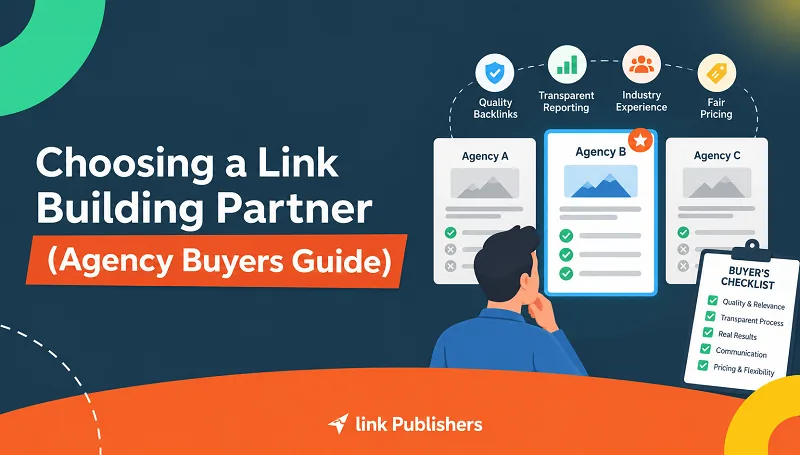
Use this framework to score any link building partner for agencies you’re considering. Rate each of the eight areas out of five, and you will quickly see which suppliers are built for agency work and which are just selling links. No single point wins it; the pattern across all eight is what tells you who to trust.
1. Process Transparency
A serious partner can show you exactly how the work gets done. If they are vague about their process, that vagueness usually hides a weak one.
Look for:
- A documented SOP for outreach, placement, and QA that they will actually share
- Willingness to show sample reports before you commit a penny
- A named point of contact, not a shared inbox where your questions go to die
The story here is simple. A partner proud of their process volunteers it. One who dodges the question is protecting something you would not like.
2. Placement Sourcing
Where your links actually come from determines whether they help your clients or quietly hurt them. This is the single biggest quality differentiator, so probe it hard.
Look for:
- Real editorial outreach to live sites, not just a recycled private inventory list
- Clear publisher vetting standards (traffic, relevance, spam checks) applied before a site is offered
- Genuine niche depth, not just a big number of total sites
A partner claiming “100,000+ sites” means little if only a handful fit your client’s niche. Depth in the niches you actually serve beats raw breadth every time.
3. White Label Fit
For white label link building, the delivery has to be invisibly yours. One leaked vendor email or branded footer in a client-facing PDF can expose your markup and damage the relationship instantly.
Before you choose a link building agency, look for:
- Client-safe reports and PDFs with no vendor branding anywhere
- No vendor emails or logos that can leak to your clients
- Data delivered in a format that plugs straight into your agency stack
Test this before you scale with a company offering white label link building for agencies. Ask for a sample client-facing report and check every page, footer, and metadata field for anything that gives the game away.
4. Pricing and Margin Structure
You are reselling, so the numbers have to leave you room to profit. A good link building reseller relationship is built on transparent unit costs and volume tiers that protect your margin.
Look for:
- Volume discounts and reseller tiers that reward your growth
- Transparent unit cost with no hidden fees bolted on later
- Enough spread between wholesale and retail to hold a healthy margin
We break the actual math down further in the pricing section below, since this is where agencies most often get squeezed.
5. QA and Replacement Policy
Links drop. A meaningful share of built links disappear over time, so what happens after delivery matters as much as the delivery itself.
During your link building vendor evaluation, look for:
- A written guarantee window, not a vague verbal promise
- Free replacement or refund when a link is lost inside that window
- A public QA checklist or process doc you can actually read
A partner who guarantees their links in writing is telling you they expect them to last. One who won’t is telling you the opposite. If you want to see what rigorous checking looks like, our backlink QA checklist lays out the exact checks worth demanding.
6. Turnaround and SLA
Your client deadlines depend on your partner’s reliability, so you need honest timelines, not best-case fantasies.
Look for:
- Median delivery time, not the fastest order they ever completed
- Order status visibility through a dashboard or API
- A clear escalation path for when something slips, because eventually it will
Ask specifically what causes delays and how often orders miss their window. An honest answer here is worth more than a polished sales pitch.
7. Communication and Support
When a client asks you a question, you need answers fast. A partner’s responsiveness directly becomes your responsiveness.
Look for:
- A response-time commitment for questions and clarifications
- A real channel (Slack, WhatsApp, or a dedicated PM) rather than a ticket black hole
- Business review calls for larger accounts, so the relationship is managed, not just transacted
Support quality is easy to test during the sales process itself. If they are slow to reply while trying to win you, they will be slower once they have.
8. Reputation and Longevity
A partner’s track record predicts your experience. New or unproven suppliers are a gamble you are taking with your clients’ budgets.
Look for:
- Case studies with named agencies, shared with permission
- Years in operation and a real team behind the platform
- Third-party reviews and genuine industry mentions
Cross-check what they claim against independent review platforms. A strong reputation built over years is hard to fake and tells you they have kept agencies happy at scale.
Quick scoring tip: rate all eight out of five. Anything scoring below three on sourcing, white label fit, or replacement policy should give you serious pause, since those three are the hardest to fix once you have scaled on them.
Pricing Models Agencies Should Understand
How you pay a link building agency shapes your margin and your flexibility. Here are the four models you will encounter, and which agency situation each one suits best.
| Model | How It Works | Best For |
| Per-link | Fixed cost per placement | Small volume, mixed or unpredictable needs |
| Retainer | Fixed monthly link budget | Agencies with predictable pipelines |
| Marketplace credit | Prepaid credits, you pick placements | Multi-client agencies wanting flexibility |
| Tiered reseller | Volume discount by monthly commitment | Established agencies with steady demand |
The margin math is what most agencies underthink. If you buy a placement wholesale and resell it, your profit lives in the gap between those two numbers, and that gap shrinks fast if a partner adds hidden fees on top. Whichever model you choose, transparent unit costs are what let you set your own retail price with confidence and protect the margin the end client never sees.
The right way to outsource link building depends entirely on how your agency works. A marketplace with prepaid credits suits agencies juggling many clients with different niche needs, while a tiered reseller arrangement rewards steady, predictable volume. A retainer brings budgeting certainty, and per-link keeps things simple for smaller or occasional needs. The strongest partners offer several of these, so you can match the model to each client rather than forcing every client through one structure.
A practical rule: whatever model you choose, make sure you can still hold a healthy margin after content, revisions, and any add-on fees. A cheap headline price with costly extras often nets worse than a transparent higher one.
Red Flags That Should End the Conversation
Some red flags in a link building agency are bad enough to walk away on the spot. Any one of these tells you the risk to your clients outweighs any discount on offer:
- Refuses to share a sample report. If they won’t show you the work before you buy, imagine the delivery.
- Prices too low to sustain real outreach. Genuine editorial placements cost money. Rock-bottom pricing usually means a private blog network behind the scenes.
- Relies on a PBN as its main inventory. This is a penalty risk you would be passing straight to your clients.
- Vague on anchor or replacement policy. Unwillingness to commit in writing means they don’t intend to.
- No named delivery lead. A shared inbox is not accountability.
- Client-facing branding leaks into deliverables. If their name shows up in a white-label report, the model is broken.
Spotting these early saves you from a partnership that looks fine in the pitch and falls apart in month two.
Questions to Ask on the First Sales Call
A good sales call tells you more than any brochure. So, here are the questions to ask a link building agency:
- Walk me through a live order from brief to delivery. Vague answers mean a vague process.
- What is your average lead time, and what causes slippage? You want the honest median and a real cause, not “it depends.”
- Show me a client-safe sample report. Check it for any branding that could leak.
- What is your replacement policy, in writing? Get the guarantee window and terms on record.
- What is the volume discount at 25, 50, and 100 links per month? This reveals whether the reseller economics actually work for you.
- Who is my named account manager, and what are their hours? Confirm you get a person, not a queue.
The best partners answer these directly and confidently, because they have nothing to hide. Hesitation on any of them is data.
How to Onboard a New Partner Without Risk
Never bet a major client on an untested link building partner for agencies. A short, structured trial tells you everything you need before you scale:
- Run a paid pilot on a low-risk client first, so any hiccup stays contained
- Set QA acceptance criteria in writing before the first order, so “good” is defined upfront
- Track four KPIs: on-time delivery, QA pass rate, replacement rate, and response time
- Review at 30 and 60 days before you commit real volume
This approach turns partner selection from a leap of faith into a measured decision. If they clear the pilot on all four KPIs, you scale with confidence. If they don’t, you found out cheaply.
When to Use a Marketplace Instead of a Managed Service
The right choice depends on how much control and support each client needs. A marketplace tends to fit when:
- You want inventory transparency and self-serve control over every pick
- You have multiple clients with different niche needs that a single retainer can’t flex to
- You prefer to pay per placement without committing to a monthly retainer
- You want to blend marketplace picks with managed campaigns, using each where it fits
The strongest setup for many agencies is a hybrid:
- Use a marketplace for the bulk of predictable, self-served placements
- Lean on managed support for the complex or high-stakes campaigns
That way you control cost where you can and buy expertise where you need it. You can see how this works on the Link Publishers marketplace, which is built for agencies to plug into with volume pricing and API access.
The Bottom Line
Choosing a link building partner is a margin decision as much as a quality decision. The right partner protects both your profit and your client relationships; the wrong one erodes both at once. Run every candidate through the eight-point framework, ask the hard questions on the first call, and never scale on a supplier you haven’t tested with a low-risk pilot.
If you are building link building into your agency’s core offer, Link Publishers is built for exactly this. Agencies plug into a transparent marketplace of 114,000+ vetted publishers with volume pricing and white-label delivery, backed by managed support when you need it.
Explore the marketplace or talk to the team about an agency partnership to see how the economics work for your book of clients.
Frequently Asked Questions
A strong link building partner for agencies offers process transparency, real editorial sourcing, genuine white label fit, healthy margin structure, a written replacement policy, honest turnaround times, responsive support, and a proven reputation. Score each area rather than judging on price alone, since the cheapest option often costs the most in lost client trust.
Yes, for agencies with steady client demand. White label link building lets you offer link building under your own brand without hiring an outreach team, protecting your margin while you scale. The key is ensuring deliverables carry no vendor branding that could leak to clients.
It depends on authority, niche, and volume, but agencies should focus on the spread between wholesale and retail rather than the headline price. A transparent partner offers volume discounts that let you hold a healthy margin after content and any extras.
A reseller sells you links at a discount to resell. A partner adds shared accountability: named contacts, written SLAs, planning, and support that scales with you. A partner has a stake in your long-term growth, while a reseller is focused on the transaction.
Run a paid pilot on a low-risk client, set written QA criteria upfront, and track on-time delivery, QA pass rate, replacement rate, and response time over 30 to 60 days. Ask for sample reports and a written replacement policy before committing volume.
)