








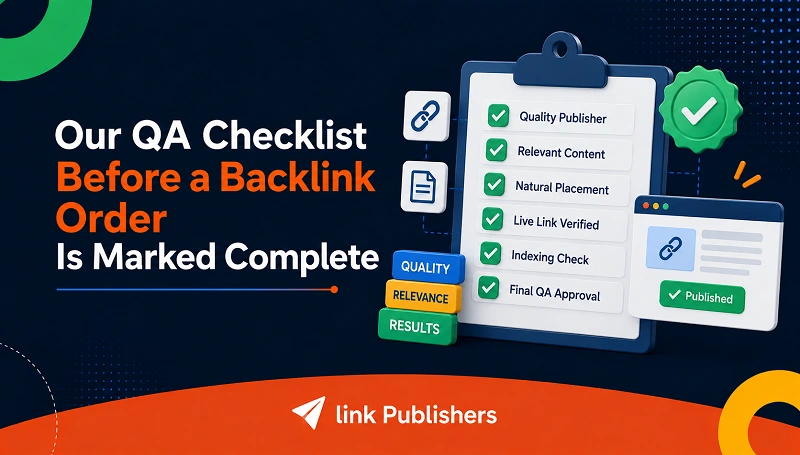
Our QA Checklist Before a Backlink Order Is Marked Complete

Explore this post with:
A backlink is not delivered the moment it goes live. It is delivered when someone has verified it actually does what you paid for: sits on a real page, passes authority, stays indexed, and does not quietly vanish a month later. The gap between “published” and “verified” is where most wasted link budgets disappear.
This is the backlink quality checklist we run on every order before we mark it complete, laid out in full so you can use it yourself. It covers the placement, the technical HTML, the health of the host site, the anchor and context, and what happens after delivery.
Why a Backlink QA Process Matters
Links vanish more often than most buyers realise. Vendors deliver, the order closes, everyone moves on, and then the link quietly disappears. Ahrefs studied link rot and found that 66.5% of links die within nine years, with a meaningful share dropping in the first twelve months. If nobody is checking, you pay for authority that erodes the day after the invoice clears.
A proper link building QA process catches these problems before the client ever sees them. It is the difference between finding a deindexed page during your own review and having a client find it during theirs.
Beyond damage control, QA is what turns link building from a leap of faith into a repeatable service. When every order runs through the same checks, quality stops depending on which vendor you happened to use that week. You get consistency you can promise clients and prove later, which is worth far more than any single link.
The 5 QA Categories
Every check we run in the backlink audit checklist falls into one of five categories. Together they cover a backlink from the moment it is placed to ninety days after delivery.
| Category | What It Covers |
| 1. Placement | Where the link physically sits on the page |
| 2. Technical HTML | rel attributes, canonical, robots, indexing |
| 3. Site Health | DR, traffic, spam score, outbound profile |
| 4. Anchor and Context | Anchor match, surrounding text, topical fit |
| 5. Post-Delivery | Live monitoring and replacement policy |
Category 1: Placement Checks
Where a link sits on a page changes how much it is worth. A link buried in a footer passes a fraction of what the same link earns inside the body of a relevant article, so placement is the first thing we verify.
The placement checks we run:
- Position on the page. The link should sit in the body content, ideally within the upper portion of the article.
- In-body, not boilerplate. We confirm the link is in the main content, not the footer, sidebar, or a throwaway author bio.
- Surrounding relevance. The two paragraphs around the link should be topically related to what is being linked, since a contextual backlink in relevant text carries far more weight.
- No link stacking. We flag any placement crammed alongside more than three other outbound links in the same paragraph, which dilutes value and looks manipulated.
- Not in a paid block. The link must not sit inside a “sponsored,” “partners,” or “advertisement” section. It signals a paid placement to Google.
A link can pass every technical check and still underperform if the placement is weak, which is exactly why this category comes first.
Category 2: Technical HTML Checks
This is the category most guides skip entirely, and it is where the real verification happens. A link can look perfect on the page and still be broken at the code level, so we inspect the actual HTML on every order.
The technical checks we run:
- The rel attribute matches the agreement. A do-follow link should be do-follow. On the wider dofollow vs nofollow question, both have their place, but you should get what you ordered, so we confirm the attribute matches the brief.
- No undisclosed rel=”sponsored” or rel=”ugc”. These tags tell Google not to pass full authority. If they are present without being disclosed, the order fails.
- A real anchor tag. The link must be a genuine HTML anchor, not a JavaScript redirect dressed up to look like one.
- Exact target URL. The link points to the ordered URL precisely, with no tracking parameters or redirects quietly added.
- Self-referencing canonical. The page canonicalises to itself, not to some other URL that would rob your link of its value.
- Indexable robots meta. The page is set to index, follow, not noindex.
- Not blocked in robots.txt. We confirm the page is crawlable and not disallowed at the site level.
- Clean 200 status. The page returns a proper 200, with no soft 404 or redirect chain sitting between the link and its destination.
Here is what a clean placement looks like in the HTML versus a broken one:
html
<!– Clean: passes authority –>
<a href=”https://yoursite.com/target-page”>your anchor text</a>
<!– Broken: passes nothing –>
<a href=”https://yoursite.com/target-page” rel=”nofollow sponsored”>your anchor text</a>
The second link is live, visible, and completely worthless for SEO. Only a code-level check catches that, which is why backlink verification has to go deeper than looking at the page.
Category 3: Site Health Checks
A perfect link on a bad site is still a bad link. Before we accept a placement, the host domain has to prove it is a real, healthy site rather than a link shop in disguise.
The site health checks we run:
- Authority against the threshold. Domain Rating and Domain Authority must meet or beat the ordered level, not fall just short.
- Cross-checked traffic. We verify organic traffic in both Ahrefs and Semrush, since a single tool can be gamed or simply wrong.
- A stable traffic trend. We look at twelve months of traffic history and reject sites with sudden cliff drops, which often signal a penalty.
- Sensible outbound links. We check how many links the page and the site send out, since a site linking to hundreds of unrelated pages leaks authority and raises flags.
- A low spam score. Anything above our fixed threshold fails. A proper toxic backlinks check at this stage keeps risky domains out before they ever touch a client profile.
- Genuine content. We screen for thin pages, AI-generated filler, and expired-domain warning signs that mark a site as built for links rather than readers.
This category is where a lot of superficially attractive sites fall down. A high DR number means little if the traffic is fake, the content is filler, or the outbound profile looks like a link farm.
Category 4: Anchor and Context Checks
The anchor text and the words around it shape how natural a link looks to Google. Over-optimised anchors are one of the clearest manipulation signals, so we treat this category carefully.
The anchor and context checks we run:
- Anchor matches the brief. The anchor is what was ordered, and it reads naturally inside the sentence rather than jammed in.
- Balanced profile. We check that the new anchor keeps the client’s overall anchor distribution healthy, so exact-match anchors do not pile up.
- Topical surroundings. The paragraph holding the link genuinely relates to the linked page, reinforcing relevance.
- No stuffing or stacking. We reject keyword-stuffed anchors and any unnatural clustering of anchors on the same page.
Anchor health is easy to overlook on a single order and painful to fix across a whole profile, so catching it link by link is far cheaper than untangling it later.
Category 5: Post-Delivery Checks
Most QA stops at delivery, which is exactly why so many links quietly disappear. Ours continues for ninety days, because a link is only valuable for as long as it stays live.
The post-delivery checks we run:
- Indexation within 14 days. We confirm the page is indexed in Google using a site: query. An unindexed link passes nothing.
- Re-checks at 30, 60, and 90 days. We verify the link is still live, still do-follow, and still pointing where it should at each interval.
- Automated drop alerts. If a link turns 404, switches to nofollow, or is removed, we get flagged automatically rather than finding out by accident.
- Replacement triggered. If a link drops inside the guarantee window, the replacement or refund process kicks in without the client having to chase it.
This is the category that protects your budget over time. Building a link is one thing; keeping it alive is what actually delivers the return.
Our Full 25-Point Checklist
Here is every check in one scannable table, so you can copy or bookmark the whole process. This is the full backlink quality control process in a single view.
| # | Check | Category |
| 1 | Link sits in body content, upper portion | Placement |
| 2 | In main content, not footer or sidebar | Placement |
| 3 | Surrounding paragraphs are relevant | Placement |
| 4 | No stacking with 3+ other outbound links | Placement |
| 5 | Not in a sponsored or partners block | Placement |
| 6 | rel attribute matches the agreement | Technical |
| 7 | No undisclosed sponsored or ugc tag | Technical |
| 8 | Real HTML anchor, not JS redirect | Technical |
| 9 | Target URL exact, no added parameters | Technical |
| 10 | Self-referencing canonical | Technical |
| 11 | robots meta set to index, follow | Technical |
| 12 | Page not blocked in robots.txt | Technical |
| 13 | Clean 200 status, no redirect chain | Technical |
| 14 | DR and DA meet the threshold | Site Health |
| 15 | Traffic cross-checked in two tools | Site Health |
| 16 | Stable 12-month traffic trend | Site Health |
| 17 | Sensible outbound link count | Site Health |
| 18 | Spam score under threshold | Site Health |
| 19 | Genuine, non-filler content | Site Health |
| 20 | Anchor matches the brief, reads naturally | Anchor |
| 21 | Anchor keeps profile balanced | Anchor |
| 22 | Surrounding paragraph is topical | Anchor |
| 23 | No stuffing or anchor stacking | Anchor |
| 24 | Indexed within 14 days | Post-Delivery |
| 25 | Live re-checks at 30, 60, 90 days | Post-Delivery |
Red Flags That Fail a Backlink Order
Some issues are bad enough to fail an order outright, no matter how the rest of the checks look. These are the signs that tell us to reject or replace a placement immediately:
- Not indexed after 30 days, which usually means the page carries no weight with Google
- Anchor swapped without notice, a sign the publisher is editing placements after the fact
- Placement moved into a paid partners section, which strips the link’s value
- A site-wide DR drop of more than 20 points, often the fingerprint of a penalty
- A sudden explosion of outbound links on the host page, which signals the site has started selling links aggressively
Knowing how to spot a PBN or a low-trust site comes down to patterns like these. Any one of them is enough to stop an order before it reaches a client.
How to Automate Parts of the QA
You cannot check everything by hand at scale, and you should not have to. Several parts of this process run well on automation, freeing your team to focus on judgment calls:
- Ahrefs Alerts flag lost or changed links across your whole profile automatically.
- Google Search Console confirms indexation and surfaces coverage issues on placement pages.
- Screaming Frog runs scheduled crawls of your placement URLs to catch status changes and broken links.
- A logged tracker with conditional formatting turns your checklist into an at-a-glance status board, green for pass, red for fail.
Automation handles the repetitive monitoring; your team handles the checks that need a human eye, like placement quality and content genuineness. That split is what lets a QA process scale without losing rigour.
Wrapping Up!
A backlink is not delivered until it is verified. Anyone can publish a link; the value lives in confirming it sits in the right place, passes authority, stays indexed, and holds up over time. That is the whole reason this backlink quality checklist runs on every order before we call it complete.
Keep the five categories in mind on your next order:
- Placement
- Technical HTML
- Site health
- Anchor and context
- Post-delivery monitoring
If you would rather skip the manual checking entirely, every publisher on the Link Publishers marketplace is vetted before it is listed, and every order comes with built-in backlink monitoring, so the QA is handled before you ever place an order. Verified links, not hopeful ones, are what actually move rankings.
Frequently Asked Questions
Run it through five checks:
Where it sits on the page
Its technical HTML (rel attribute, canonical, indexability)
The health of the host site (DR, traffic, spam score)
The anchor and surrounding context
Whether it stays live after delivery
A link needs to pass all five to count as quality.
Inspect the link’s HTML and look at its rel attribute. If there is no rel=”nofollow”, rel=”sponsored”, or rel=”ugc” tag, the link is do-follow and passes authority. A free do-follow link checker or your browser’s inspect tool both reveal this quickly.
Search Google for the exact URL of the page holding your link using a site: query, or check the page in Google Search Console. If the page does not appear, it is not indexed. And an unindexed link passes no value until Google crawls and includes it.
For active campaigns, check indexation within the first two weeks. Then re-verify at 30, 60, and 90 days to catch drops early. Beyond that, a full profile audit every quarter keeps your quality backlinks working and flags any that have decayed.
Ahrefs and Semrush for authority and traffic, Google Search Console for indexation, Screaming Frog for crawling placement pages, and your browser’s inspect tool for reading the HTML. A logged spreadsheet ties it together into a trackable process.