Link Building Marketplace vs. Link Building Agency: Which Is Better for Your Business?

Explore this post with:
Short answer: a marketplace is better if you want control and per-link pricing. An agency is better if you want strategy and a hands-off setup. A hybrid works if you want a bit of both. Not sure which one sounds like you? Keep reading.
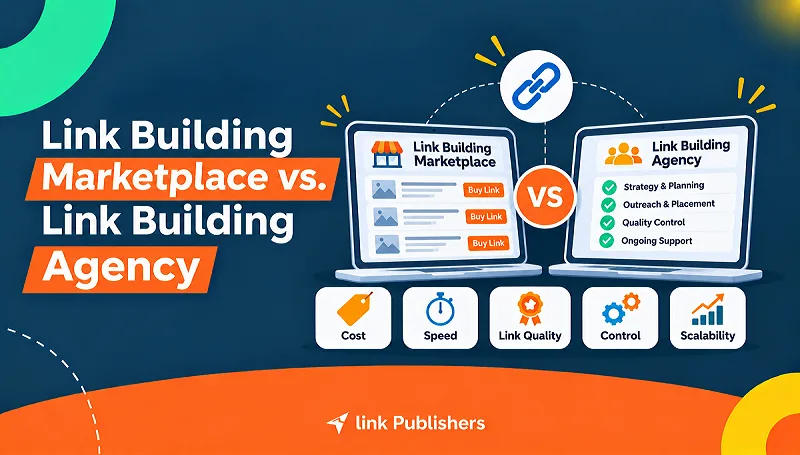
Link Building Marketplace vs Agency at a Glance
Here’s the quick version. We’ll dig into each row after this.
| Marketplace | Agency | |
| Cost model | Pay per link | Monthly retainer or per link |
| Control | High. You pick the site and anchor | Medium. They pick, you approve |
| Transparency | You see the site before you pay | Often a list after the work starts |
| Speed | Days to a couple of weeks | Slow start, then steady |
| Quality vetting | You check it yourself | They check it for you |
| Strategy | You bring your own | Comes with the service |
| Your time | More | Less |
| Scalability | Easy to scale up or down | Limited by their team |
| Best for | Buyers who know what they want | Buyers who want it done for them |
What Is a Link Building Marketplace?
Think of it like an online store, but for backlinks. A link building marketplace lists real websites that accept guest posts or link placements. You browse them, check the numbers, and buy the ones you like.
That’s about it. You decide, you order, you pay.
Most marketplaces work in three steps. First, you browse and filter by niche, traffic, authority, and price. Then you place an order and add your anchor text and target page. Finally, the post goes live, and you get the link.
[ Browse and filter sites ]
            |
            v
[ Pick a site, add anchor text, pay ]
            |
            v
[ Placement goes live, you get the URL ]
The big plus is that nothing is hidden. You see the domain first.
What Is a Link Building Agency?
An agency does the work for you. You pay them, and they handle the research, the outreach, the content, and the reporting.
Some charge a monthly retainer. Others charge per link. Either way, you’re mostly buying their time and know-how, not a menu of sites.
A normal agency process looks like this:
[ Kickoff call and site audit ]
              |
              v
[ Strategy and target list ]
              |
              v
[ Outreach and content creation ]
              |
              v
[ Links go live over several weeks ]
              |
              v
[ Monthly report ]
It’s slower to start. But once it’s rolling, you don’t have to touch much.
8 Key Differences Between Link Building Marketplaces and Agencies
Let’s go through the stuff that actually changes your day-to-day.
Cost and Pricing Model
Marketplaces charge per link. You know the price before you click buy. If a link costs one amount, that’s what you pay.
Agencies mostly work on retainers. One survey of 439 SEO providers by Ahrefs found the average agency retainer sits at roughly $3,000 a month. That fee covers strategy, outreach, content, and reporting, not just links. So it’s hard to say what one link costs you.
Neither is cheap or expensive by default. It depends on what you need. If you only want links, you might be paying for a lot you don’t use with a retainer. Also if you need the full package, per-link pricing leaves gaps you’d have to fill yourself.
If you’re comparing niche edit options in particular, our guide on niche edit pricing breaks that down.
Winner for most buyers: Marketplace. The price is clear up front.
Control Over Sites and Anchor Text
In a marketplace, you pick the site. You pick the anchor text. You pick the page it points to.
With an agency, you usually get a list of sites to approve. Some let you reject sites freely. Some push back. You’re trusting their taste.
Control matters more than people think. A site that looks fine on paper might feel off for your brand. When you’re the one choosing, you catch that.
Winner for most buyers: Marketplace.
Transparency Before You Pay
This one’s simple. Can you see the website before you spend money?
On a marketplace, yes. Domain, traffic, niche, price, all right there. No surprises.
With agencies, it varies. Good ones share their site lists and reporting. Others only show you the links after they’re live. That’s not always bad, but you’re paying first and checking later.
Winner for most buyers: Marketplace.
Speed and Turnaround
Marketplaces are quicker. Place an order today and many posts go live within days or a couple of weeks.
Agencies need time. They audit, plan, pitch and wait for replies. The first links can take a month or more. After that it speeds up, and the flow is steady.
So if you need something live this month, a marketplace fits better. If you’re building for the next year, the agency’s slow start doesn’t matter much.
Winner for most buyers: Marketplace for fast results, agency for steady ones.
Link Quality and Vetting
This is where agencies earn their money. A good one checks every site for real traffic, clean link profiles and topic fit. You don’t have to know what to look for.
On a marketplace, vetting is shared. The platform screens sites, but you still need to check metrics and fit. If you know SEO, that’s easy. If you don’t, it’s easy to pick a weak site by mistake.
Quality depends on who’s doing the checking, not on which model you pick. A sloppy agency is worse than a careful marketplace.
Winner for most buyers: Agency, if you can’t judge sites yourself. Marketplace, if you can.
Strategy and Expertise
Marketplaces sell links. They don’t tell you which links to buy.
Agencies do. They look at your competitors, your gaps and your goals, then plan what to build. For complex campaigns, digital PR or a site with no in-house SEO person, that’s a real strength.
Be honest with yourself here. If you don’t have a plan, a marketplace won’t give you one.
Winner for most buyers: Agency.
Time and Effort on Your Side
With a marketplace, you do the browsing, the ordering, the briefs and the checking. It’s not hard, but it adds up. A few hours a month, sometimes more.
With an agency, you mostly approve things and read reports. Your team’s time goes elsewhere.
If your calendar is already packed, that matters.
Winner for most buyers: Agency.
Scaling Up (Including White-Label for Agencies)
Marketplaces scale easily. Need 5 links this month and 25 next month? Just order more. No contracts to renegotiate.
Agencies scale too, but they’re limited by headcount. Ask for double the links and they may need weeks to staff up.
There’s also a white-label angle. SEO agencies and resellers often use marketplaces to fill client orders fast, without building their own outreach team. It keeps margins healthy and delivery quick.
Winner for most buyers: Marketplace.
When a Marketplace Is the Better Choice
A marketplace usually fits when:
- You already know what links you want and just need a place to buy them.
- You have an in-house SEO person who can check sites and write briefs.
- You want to pay per link and avoid a monthly contract.
- Your budget is tight, or it changes from month to month.
- You run an SEO agency and need white-label links for clients, fast.
If three or more of those sound like you, start here.
When an Agency Is the Better Choice
Agencies aren’t the bad guys in this story. They’re the right call when:
- You don’t have anyone in-house who knows SEO.
- You’re running a complex campaign, like digital PR or a big content push.
- You want one team to own strategy, outreach and reporting.
- Your time is the real bottleneck, not your budget.
- You need links from hard-to-reach sites that take real relationship building.
Digital PR is a good example. Getting a news site to cover you takes pitching, patience and contacts. That’s not something you click and buy.
The Hybrid Option: Managed Link Building Inside a Marketplace
Here’s the third path. And honestly, it’s where many teams end up.
A hybrid gives you a marketplace with managed help built in. You can still browse and buy links yourself when you know what you want. When you need strategy or outreach, you hand that part to a team.
That’s how Link Publishers works. You get self-serve inventory plus managed link building services and guest posting services in one place. One account. One dashboard. No juggling two vendors.
It also means you’re not locked in. Do the easy stuff yourself, and pay for expertise only where you need it.
Want to see how it feels? Create your free account on the Link Publishers marketplace and browse the inventory yourself.
Which Link Building Model Fits Your Business?
Different businesses need different setups. Here’s a rough guide.
| Business type | Best model | Why |
| Startup or small business | Marketplace | Low budget, pay only for what you buy |
| SaaS company | Hybrid | Needs quality sites and some strategy |
| Ecommerce store | Marketplace or hybrid | Many pages to support, flexible spend |
| Local business | Marketplace | Few links needed, local sites matter |
| SEO agency or reseller | Marketplace (white-label) | Fast delivery, easy to scale for clients |
| Enterprise | Agency or hybrid | Bigger campaigns, more approvals, more reporting |
These aren’t rules. Treat them as a starting point.
Link Building Cost Example: 10 Links a Month, Three Ways
Let’s put some numbers next to this. Say you want 10 links a month.
Marketplace. You buy 10 placements at around $100-200 per link. You also spend time picking sites, writing briefs, and checking live posts. I’d budget around 8 hours a month.
Agency. The Ahrefs survey average is roughly $3,000 a month. If that retainer actually delivers 10 links, you’re at about $300 a link. But many retainers promise fewer links, because the fee also covers strategy and reporting. Your time is light, maybe 2 hours a month for calls and approvals.
Hybrid. Say 6 links bought yourself and 4 handled by a managed team. The self-serve links cost around $100- 200 each, and the managed ones cost around $300-400 each. Your time sits in the middle, around 4 hours.
Time estimates are rough and vary by team. And remember, an agency retainer buys more than links. If you value the strategy, that changes the math.
How to Evaluate a Link Building Marketplace or Agency Before You Commit
Whichever way you go, ask these questions first:
- Can I see the domain before I pay?
- What’s the replacement policy if a link is removed or the site drops?
- Are paid posts labeled properly, with rel=”sponsored” where needed?
- How is site traffic verified, and by whom?
- Who writes the content, and can I review it?
- What does reporting look like, and how often do I get it?
- Are there lock-in contracts or minimum spends?
- Can I talk to a real person when something goes wrong?
If a provider dodges any of these, that tells you something.
Want more detail? Read our guide on how to choose a link building agency. And if you’re already unhappy with one, see when to fire your link building agency. You can also compare top guest post marketplaces, best link building platforms, and freelancer vs agency.
Frequently Asked Questions
They can be, if you use them well. The risk isn’t the marketplace. It’s the sites you pick. Choose real sites with real traffic and relevant topics, and keep your anchor text natural. Check the marketplace features that help with that, like site metrics and replacement policies.
Google’s spam policies say that links bought mainly to pass ranking signals count as link schemes. But paid content isn’t banned outright. Google asks that paid or sponsored links be marked with rel=”sponsored” or rel=”nofollow”. Read Google Search Central’s spam policies yourself, so you know where the line sits.
It varies a lot. The Ahrefs survey of 439 providers found an average around $3,000 a month, but smaller packages cost less and big campaigns cost far more. Always ask what’s included, and how many links you’ll actually get.
Yes, and lots of teams do. An agency can handle strategy and hard outreach while you fill gaps through a marketplace. Just make sure they’re not building links to the same pages with the same anchors. Overlap looks messy.
Some do. Many agencies buy placements from marketplaces, then add their own strategy and reporting on top. That’s not a secret or a scandal. It’s just how part of the industry works. If it matters to you, ask your agency where their links come from.