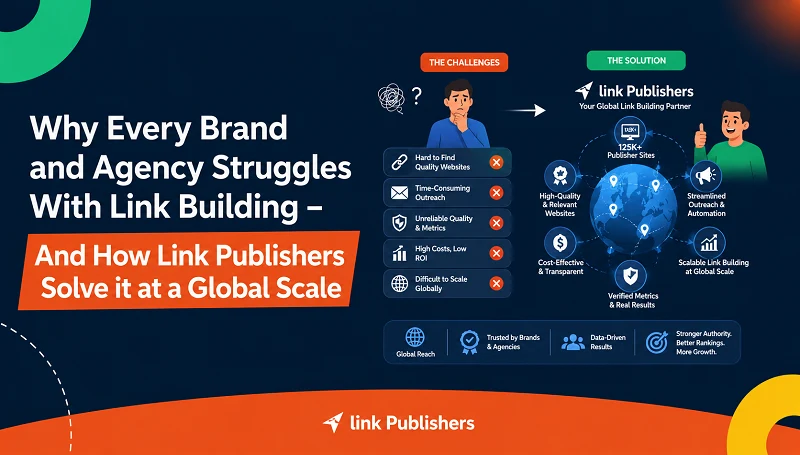
Why Every Brand and Agency Struggles With Link Building - And How Link Publishers Solve it at a Global Scale

Explore this post with:
52.3% of marketers consider link building to be the hardest part of SEO. The global link building market crossed $25.97 billion in 2025. And yet, most brands are still getting it wrong.
The Link Building Problem Is Universal – Whether You’re a Brand or an Agency
Here’s something we’ve noticed after discussing with hundreds of marketers, agency owners, and founders: it doesn’t matter if you’re running a two-person startup or sitting inside a Fortune 500 marketing team. Everyone eventually hits the same wall with the same link building problems. Getting consistent and high-quality backlinks is just hard.
Backlinko’s research found that pages at position #1 have roughly 3.8 times more backlinks than everything ranked 2 through 10. That gap isn’t small. If your content isn’t earning links, it’s going to struggle to rank, plain and simple.
But the real problem is not that businesses don’t know link building matters. Almost everyone knows. The actual link building problem is execution – finding the time, the quality publishers, the budget, and the scale to actually make it happen every month.
That’s what this post is really about. We’ll walk through why link building has gotten so much harder in 2026, break down the seven problems nearly every business runs into, look at how those problems show up differently depending on what kind of business you run, and then talk about how Link Publishers is built to solve all of it, without the usual headaches.
Stick with us through this one. It runs a bit longer than our usual posts, but if you’ve ever felt like link building quietly eats time and budget without much to show for it, this should explain why, and more importantly, what actually helps.
Why Link Building Has Become the Hardest Thing in SEO
A few years back, link building was mostly about outreach volume. Send enough emails, get enough replies, land enough links. Simple, if a little tedious. That playbook doesn’t really work anymore.
Google’s gotten a lot better at spotting low quality links, and a lot less forgiving about them. Thin sites, obvious link patterns, PBN-style setups – these carry real ranking risk now, not just wasted effort.
Outreach has gotten slower too. Editors are pickier, and good publishers get pitched constantly, so they’ve raised their standards. Even experienced SEO teams spend hours prospecting and pitching, only to see most of it go nowhere.
The numbers back this up. As per the link building statistics 2026,
- Around 75% of businesses say they’re planning to increase their link building budgets this year.
- Meanwhile, 52.3% of marketers already rank it as the single hardest SEO task on their plate.
Those two stats together tell you everything – demand is rising, but the old methods aren’t keeping pace.
And the shortcuts that used to work? PBNs, link farms, fully automated outreach at scale – these don’t just underperform now; they actively put your rankings at risk. Google’s gotten too good at spotting the pattern.
What makes this trickier is that the definition of “good link” keeps shifting. A site that passed every quality check two years ago might look completely different today – different ownership, different editorial standards, sometimes even a different niche entirely after being flipped. Keeping a link profile clean now takes ongoing vetting, not a one-time check during the outreach phase.
7 Link Building Problems Every Brand and Agency Faces Right Now
Talk to enough SEOs, and you’ll notice the same handful of complaints keep coming up, no matter the industry. Here’s what some of the link building problems usually sound like.
Manual Outreach Eats Your Entire Week
Prospect, verify, email, follow up, wait, and maybe – maybe – you land one link. Templated outreach campaigns typically see response rates around 1 to 2%. That’s a brutal ratio when you consider how much time goes into each pitch, and how much of that time never turns into anything you can actually report on.
Finding Niche-Relevant Publishers is Exhausting
Generic links barely move the needle anymore. If you’re in fintech or healthcare, tracking down twenty genuinely relevant sites willing to publish your content can eat up several days on its own, and that’s before you’ve confirmed any of them are worth pitching in the first place.
Link Quality is Impossible to Verify Without Tools
This one surprises people. Roughly 98% of the sites on typical guest post marketplaces are low quality – think under 10,000 monthly visits and a Domain Rating below 40. Without a paid tool subscription, most buyers are essentially guessing, and even with the tools, cross-checking each site manually adds hours to every order.
Scaling is Impossible With Manual Methods
Say a client wants 50 links a month. Your team, realistically, can manage maybe 10 to 15 with any real quality control. Hiring more people adds cost and management overhead, with zero guarantee the quality holds up, and by the time new hires are trained, the client’s expectations have already moved on.
Turnaround Times Wreck Deadlines
Publishers go quiet mid-project. Content gets delayed. Three to four week waits become the norm rather than the exception. Agencies lose retainers over this more often than you’d think – clients don’t care why the link is late, they just notice it’s late, and “the publisher went quiet” is not an explanation that saves a renewal conversation.
Budgets Become Unpredictable Fast
The average cost of one solid backlink sits around $508.95. Without fixed pricing, there’s no real budget framework, no predictable return, and finance teams start asking uncomfortable questions right around the time you need their approval for next quarter’s spend.
No Centralised Reporting or Tracking
Managing link campaigns for ten clients across ten different spreadsheets is its own kind of chaos. No single dashboard showing live status, Domain Authority, Domain Rating, or delivery timelines – just a mess of tabs and Slack messages, and someone always asking “wait, did that link go live yet?”
Individually, these link building problems are annoying. Stacked together, they’re the reason so many link building efforts quietly wash out halfway through the quarter, right when momentum matters most.
The Same Problem Looks Different for Every Type of Business
Here’s the thing though: while everyone deals with these seven issues, they don’t show up the same way for everyone. Where you sit determines which of these hurts most.
Why E-Commerce Brands Struggle to Get Backlinks
E-commerce has a strange challenge that other industries don’t deal with as much. Bloggers and journalists tend to see product pages as advertising, not as something worth linking to. So naturally earning links to a category or product page almost never happens.
What actually works is building domain-wide authority through supporting content, then letting that authority flow toward the commercial pages that need it.
This is exactly where Link Publishers helps. You can browse more than 25,000 vetted publishers across lifestyle, fashion, and tech niches, and buy guest posts designed to funnel authority right back to the pages driving revenue.
Think of it less as “getting a link to your product page” and more as building a web of relevant content around your store that search engines and readers both trust – the commercial pages benefit indirectly, but consistently.
Why SaaS Companies Can’t Rank Without the Right Backlinks
For SaaS and tech startups, the issue is usually resourcing. Building links in-house is expensive, slow, and needs a level of specialized expertise.
Besides, SaaS companies need links from tech publications, review platforms, and industry-specific blogs. Random guest posts on unrelated sites just don’t carry the same weight.
Link Publishers lets you filter by niche (SaaS, B2B, Tech), by Domain Authority, and by traffic, so you find the right publishers in minutes instead of days.
For a lean marketing team already stretched across product launches and demand gen, that time saved is often the difference between hitting the link-building goal for the month or quietly letting it slide.
Why Agencies Hit a Link Building Ceiling With Every Client
Agencies run into a slightly different wall. Quality backlinks usually depend on journalist relationships that take years to build. That’s not something you can rush, and it’s why white label link building services has become close to essential for agencies trying to grow.
What agencies actually need is white-labeled delivery, the ability to order in bulk, and reporting they can hand straight to clients without extra work.
That’s the core of what Link Publishers offers agencies – white-label reports, bulk ordering, a single dashboard for managing every client, and a 30 to 32 hour delivery guarantee that makes deadlines predictable again.
For account managers, that predictability alone tends to matter more than almost anything else, since it’s usually missed deadlines, not missed strategy, that put a retainer at risk.
Why Local Businesses Stay Invisible Without a Backlink Strategy
Local and small businesses are up against national brands with massive link profiles, but usually without the budget for a full agency retainer. That combination leaves a lot of small businesses stuck – visible in theory, invisible in search results.
Link Publishers keeps this accessible with per-link pricing, the ability to filter by country and city-level niche, and no long-term contracts locking anyone in. A local bakery or a regional law firm can order exactly what fits the budget that month, scale up when business is good, and pull back when it isn’t, without any awkward contract renegotiation.
Why Even Big Brands Struggle With Niche-Relevant Link Building
You’d think enterprise brands would have this solved, but scale creates its own headaches. Large brands need links across multiple markets, multiple languages, and multiple niches, often all at once. Internal teams just can’t manage that volume while also maintaining quality control.
With 25,000+ publishers across more than 50 countries, Link Publishers turns global link building into something that runs from a single platform, instead of a dozen disconnected efforts. Instead of one team handling US publishers, another vaguely trying to cover Europe, and a third scrambling for anything in APAC, it all sits in one place with the same verification standard applied everywhere.
How Link Publishers Solves Every One of These Problems at a Global Scale
So how does this actually work in practice? It comes down to replacing the manual, unpredictable parts of link building with something structured and verified. Laid out side by side, the shift looks like this:
| Link Building Problem | Link Publishers Solution |
| Manual outreach time | Pre-vetted publishers – no outreach needed |
| Niche relevance | Filter by niche, DA, DR, traffic, country |
| Link quality | Every publisher is manually verified – full metrics are visible |
| Scaling | Unlimited orders across multiple campaigns |
| Turnaround | 30 – 32 hour guaranteed link delivery |
| Budget unpredictability | Fixed per – link pricing – no surprise costs |
| Reporting | Live dashboard – order status, metrics, completion rate |
| White label | Unbranded reports for agency clients |
| Global reach | Publishers across USA, UK, India, Australia + 50 countries |
| AI-powered matching | ReleVink AI matches your niche to the best publishers |
None of this works as a checklist on its own. It’s really one connected system. The filtering only matters because every publisher behind it has already been manually verified, so what you’re filtering through is quality to begin with, not a mixed bag you still have to vet yourself. That verification is also what makes the 30-to-32-hour delivery window realistic, since there’s no back-and-forth with an unfamiliar site to slow things down.
Fixed pricing follows from the same setup. When publishers are already vetted and organized, there’s no negotiation per link, just a rate you can budget against. And the live dashboard ties it together for anyone managing more than one campaign, showing order status, metrics, and completion rate without a separate spreadsheet for every client.
For agencies, all of that reporting can go out unbranded, ready to forward straight to a client. And ReleVink, the platform’s own matching system, is what makes the niche filtering fast rather than tedious. It’s built to point you toward the most relevant publishers automatically instead of leaving you to scroll through thousands of listings, guessing at fit.
What Brands and Agencies Are Achieving With Link Publishers
Numbers tend to say more than adjectives here. Link Publishers currently works with over 13,000 advertisers and more than 25,000 publishers. It has helped build over 71,550 backlinks so far.
- One agency using the platform for multi-client campaigns mentioned they cut their average link delivery time from nearly a month down to under two days, simply by removing manual outreach from the process entirely.
- An e-commerce brand in the home goods space reported steadier organic growth after shifting its link strategy toward content assets instead of chasing links directly to product pages.
- A SaaS marketing lead told us the filtering by niche and Domain Rating alone saved their small team close to ten hours a week that used to go into manual publisher research.
As one client put it: “We stopped worrying about whether the link would actually show up. It just does.”
That kind of consistency is rare in this industry, and it’s exactly what compounds over time. Most of the SEO progress that looks sudden from the outside is really just the result of a lot of unglamorous, on-time link building happening in the background, month after month, without anyone having to chase it.
From Local Business to Global Brand – The Link Publishers Difference
Authority doesn’t build overnight. It builds with consistent link building, month after month, so rankings keep compounding instead of stalling out.
Brands that keep at it alongside solid content tend to grow organic traffic 2x faster than brands that focus only on content. Trust signals add up over time, and that shows.
There’s also a visibility side people forget about. Getting featured on publishers across the USA, UK, Australia, and India puts your brand in front of new audiences, not just in a backlink report. And when that coverage comes from real publications, it feeds directly into the E-E-A-T signals Google already looks for – experience, expertise, authority, and trust.
Going global was never really about having a huge budget. It’s about having access to the right publishers in the first place. That’s the piece Link Publishers was built to provide.
Stop Struggling With Link Building, Start Building a Global Brand Today
Link building is hard. It’s hard for startups, hard for agencies juggling ten clients, and hard for enterprise brands managing global campaigns. That part isn’t going to change.
What can change is how much of that difficulty you’re absorbing yourself. Pre-vetted publishers, fixed pricing, guaranteed delivery windows, and reporting that doesn’t require a spreadsheet marathon – that’s the difference between link building being a constant headache and being just another reliable part of your marketing operation.
If you’re tired of chasing outreach replies that never come, it might be worth seeing what a verified publisher network can actually do. Most teams that switch over say the same thing – not that it’s flashy, just that it finally feels manageable.
Sign up to Link Publishers or explore the marketplace and see how quickly things can move when the guesswork is gone.
Frequently Asked Questions About Link Building for Brands and Agencies
It depends entirely on where those links come from. Buying placements on low-quality, spammy sites carries real risk under current Google spam policies. Working with manually verified, editorially legitimate publishers, like Link Publishers, is a different story altogether, and is standard practice across the industry.
There’s no fixed number. And anyone promising an exact figure is guessing. It depends heavily on your niche competitiveness and current authority. What matters more than raw count is consistency and relevance. A steady stream of niche-appropriate links tends to outperform a one-time bulk purchase, even a large one.
Manual outreach depends on cold emails, follow-ups, and hoping an editor responds. Link Publishers removes that entirely – publishers are pre-vetted and ready to accept orders, so there’s no pitching, no waiting on replies, and no guessing about quality.
Yes. The dashboard is built with agencies in mind, supporting bulk ordering and white-labeled, client-ready reporting across as many accounts as needed.
Publishers span lifestyle, fashion, tech, SaaS, finance, health, local business categories, and more, across over 50 countries – so most industries will find relevant options.







Entity SEO: How Strategic Link Building Builds Entity Authority in 2...
Link Building Methods Compared: Which Strategy Works Best in 2026?