








Brand Mentions vs Backlinks: What Actually Moves Rankings in 2026?

Explore this post with:
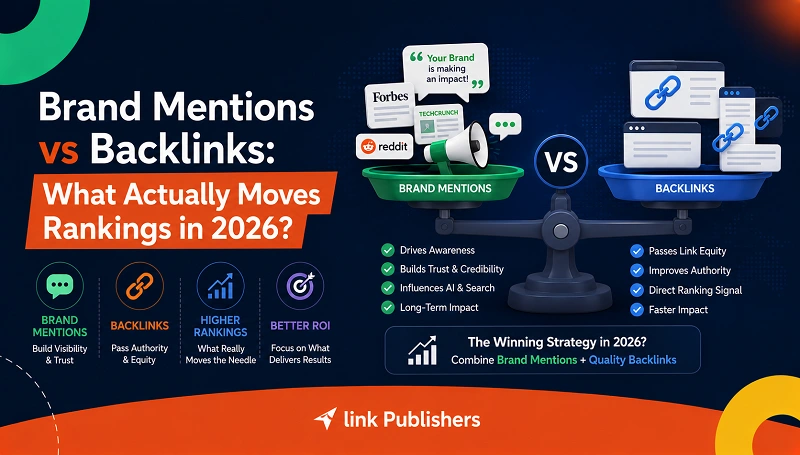
Backlinks still move rankings in 2026, but they no longer work on their own. In the Brand Mentions vs Backlinks discussion, Brand mentions now carry significant weight in off-page influence, and AI search engines rely heavily on them when deciding which brands to trust and cite. The old playbook of chasing links and ignoring everything else has stopped working.
For two decades, links were the whole game. You earned them and you watched your rankings climb: that was off-page SEO. That model held up until AI Overviews, zero-click results, and entity-based ranking changed how both Google and AI platforms decide who deserves visibility. Today, a competitor with a thinner link profile can outrank you in AI answers simply because more people talk about their brand across the web.
This guide settles the brand mentions vs backlinks question properly. We will cover:
- What each signal does
- How Google and AI systems weigh them
- When to prioritize one over the other
- Why the strongest results come from running both together
What Are Backlinks?
A backlink is a clickable hyperlink from one website to another. When a site links to your page, it passes along a portion of its authority, which search engines read as a vote of confidence in your content.
That authority transfer is called link equity, and not all of it is equal:
- A trusted, relevant link carries far more equity than an obscure or unrelated one
- A single strong link often outperforms dozens of weak ones
- Placement matters, since Google weighs where the link sits within the content
Two types earn the most trust:
- Editorial backlinks — included because a real publisher found your page genuinely useful
- Contextual backlinks — placed within the body of relevant text, not in a footer or sidebar
High authority backlinks remain a confirmed ranking signal, and the correlation still holds strongly for competitive commercial queries. What changed is their exclusivity. Links used to be the only off-page signal worth chasing, and now they share the stage with something Google has learned to measure just as carefully.
What Are Brand Mentions?
A brand mention is any online reference to your business, whether or not it includes a link. Someone naming your company in a blog post, a Reddit thread, or a news article creates a signal that search engines and AI systems both notice.
Mentions come in a few distinct forms:
- Linked mentions — include a hyperlink and pass authority like any backlink
- Unlinked mentions — name your brand without a clickable link, registering as an entity signal, even though no link equity flows
These unlinked references are what practitioners call implied links SEO has discussed for years, drawn from a 2014 Google patent describing a reference to a resource that stops short of an actual hyperlink.
Two related mechanics deserve attention:
- Co-citation — your brand appears alongside related brands or topics across sources, teaching search engines which category you belong to
- Co-occurrence — your brand name sits near specific keywords repeatedly, strengthening the association between your business and those topics
Here is the difference in practice. A linked mention says “go to this site.” An unlinked brand mention says “this brand exists and matters in this space.” Both build authority through separate channels, and modern search weighs both when judging how relevant and trustworthy your brand is.
Brand Mentions vs Backlinks: Key Differences
Both signals build authority, yet they do different jobs. The table below breaks down where each one delivers.
| Factor | Backlinks | Brand Mentions |
| Direct SEO value | Strong | Partial |
| Authority building | Strong | Strong |
| Referral traffic | Yes | Rarely |
| AI citations | Partial | Strong |
| Brand awareness | Partial | Strong |
| Trust building | Strong | Strong |
Backlinks influence Google most directly. They pass link equity, drive clickable referral traffic, and remain a measurable input into traditional rankings. When you compete for a high-value commercial keyword, a strong link profile is still what separates page one from page two.
Brand mentions influence AI search most directly. They rarely send referral traffic on their own, though they build the entity recognition AI platforms that underpin their brand-naming decisions. Research from Search Atlas found that unlinked brand mentions now initiate roughly 60% of new Knowledge Panels, while backlinks account for about 35%.
The value shifts with your goal:
- Chase backlinks when you need to rank a specific page for a competitive term and drive direct traffic
- Prioritize mentions when you want broad recognition and visibility inside AI-generated answers
Most businesses need both, at different intensities for different objectives.
How Google Uses Backlinks and Brand Mentions
Google processes both signals through separate systems that ultimately feed the same judgment about your authority.
Backlinks flow through the link equity model
They flow through the link equity model that has underpinned Google’s algorithm since PageRank. Each quality link passes trust and builds domain credibility, and diverse links from many sites signal broader endorsement than repeated links from one source. This part of Google’s evaluation has stayed remarkably consistent.
Brand mentions feed a different mechanism built around entities
Google’s Knowledge Graph maps your brand as a distinct entity connected to specific people, products, and topics. Every time a trusted source mentions your business alongside relevant subjects, Google strengthens those connections and becomes more confident in what your brand represents. This is where entity authority takes shape.
E-E-A-T sits across both signals
Google’s quality systems reward Experience, Expertise, Authoritativeness, and Trustworthiness, and both links and mentions feed those judgments. A backlink from an authoritative publication signals trust, and so does a mention from a respected industry source, even without a link attached.
The bigger shift is relational. Google no longer evaluates your site in isolation. It evaluates the relationships between your brand, the entities around it, and the trusted sources that reference you. Links map part of that web, mentions map another part, and together they tell Google who you are.
How AI Search Evaluates Authority
AI search platforms judge authority differently from Google, and the gap explains why some brands dominate ChatGPT answers while others with strong links stay invisible.
ChatGPT, Gemini, Perplexity, and Google AI Overviews are trained on vast amounts of web text, where they learn which brands appear repeatedly in trusted contexts. The distinction is simple:
- A backlink tells these systems where to navigate
- A mention tells them what to trust
For deciding which brand to recommend, trust is the signal that matters more, which reshapes how you approach AI search SEO.
The correlation data make this concrete:
- Branded web mentions correlate with AI Overview visibility at 0.664, against 0.218 for backlinks — roughly three to one
- YouTube mentions showed the strongest correlation of all at about 0.737, pointing to how much AI weighs mentions across varied media
- Nofollow links correlate with AI citations almost identically to dofollow links, with less than a 2% difference
That last point makes placements on Wikipedia, Reddit, and Quora strategically valuable, since their nofollow links still build the mention density AI systems reward.
| Signal | Google Search | AI Search |
| Backlinks | High | Moderate |
| Brand mentions | Moderate | High |
| Citations | Moderate | High |
| Entity authority | High | Very high |
Backlinks still matter for AI, though more as a threshold than a scoreboard:
- Your domain needs enough authority to be considered by AI retrieval systems at all
- Once past that bar, mentions and content structure do most of the work deciding whether you get named
- The threshold effect is sharp: median AI mentions jump 3.7 times between the 80th and 90th percentile of domain authority
When Backlinks Matter More
Backlinks take priority whenever you need to rank a specific page for a competitive term. Certain situations lean heavily on link strength:
- New websites need links to establish baseline authority, since a fresh domain has no track record and links are the fastest way to signal legitimacy
- Competitive commercial keywords reward strong profiles, because when ten well-resourced rivals chase the same term, the page with more relevant links usually wins
- E-commerce and SaaS money pages depend on links, since product and category pages rarely attract them naturally
- Local SEO leans on links from regional and industry-relevant sites for geographic authority
The SaaS case shows why this matters. A brand fighting for “best project management software” needs authoritative links pointing at that comparison page, because the term is too competitive to rank on relevance alone. This is exactly where a focused link building strategy earns its budget.
When Brand Mentions Matter More
Brand mentions take priority whenever recognition and AI visibility outrank the need to move a single page:
- PR-driven campaigns thrive on mentions, since coverage across publications spreads your brand name far wider than a handful of links
- Brand awareness goals depend on mentions almost entirely, because no amount of link equity helps if people do not know you exist
- AI search visibility runs on mentions more than anything, since ChatGPT and Perplexity recommend brands named consistently across trusted sources
- Enterprise and reputation management favor mentions, where sentiment and frequency shape how users and algorithms perceive you
The awareness point compounds over time. Mentions across podcasts, roundups, and social threads put your name in front of audiences who later search for you directly, which lifts branded search volume, itself a signal AI platforms read. This is where AI search visibility is won or lost, and it explains why mention-rich brands keep appearing in AI answers while link-heavy competitors do not.
Why Brand Mentions Alone Aren’t Enough
Mentions build awareness, but awareness without authority rarely converts into rankings for the pages that drive revenue. A brand can be mentioned widely and still fail to rank its commercial pages if it has no link equity behind them.
Here is the gap on each side:
- Mentions alone tell search engines your brand exists and matters, but do not pass the concentrated authority a competitive commercial page needs
- Links alone rank your money pages but leave you invisible in AI search
That job of ranking commercial pages still falls to backlinks SEO. One signal builds trust and recognition, the other builds ranking power, and each covers the other’s blind spot. This is why the either-or framing misleads. They do different jobs, and you need both jobs done.
The Best Strategy: Combine Backlinks and Brand Mentions
The strongest off-page strategy in 2026 is to build links and mentions together through a single, connected workflow. The two signals reinforce each other, and the activities that produce one often produce the other at the same time.
The evidence for combining them is direct. Semrush’s 2026 survey found a clear split:
- 81% of organizations that fully integrate SEO and AI visibility reported increased traffic or leads from AI platforms
- Only 36% of those managing the two separately reported the same (Semrush, 2026)
Integration more than doubles the payoff. The workflow itself flows in a logical sequence:
- Guest posting earns editorial links while placing your brand name inside relevant content, producing a link and a mention in one act
- Digital PR amplifies your brand across publications, generating the earned mentions that AI systems weigh heavily
- Entity authority strengthens as those mentions accumulate, feeding your visibility inside AI answers
Each service fits together rather than competing:
- Guest posting services build contextual links and brand exposure at once
- Digital PR services earn the high-authority mentions that pure link building misses
- Link building services keep your authority foundation strong enough to clear the thresholds both Google and AI systems set
Run in sequence, they compound rather than duplicate effort.
How Different Link Building Strategies Support Brand Authority
Each link building method contributes something distinct. Here is what each one delivers before the summary table:
- Guest posting builds authority and exposure together, earning a contextual link, naming your brand to a new audience, and often getting referenced later by other writers
- Digital PR specializes in mentions at scale, earning coverage across publications you could never reach through direct link requests
- Niche edits add context and speed by placing your brand inside existing, indexed content that already ranks
- Editorial links build trust above all, signaling the strongest form of endorsement to search engines and AI systems
Niche edit services work especially well when you need relevant placements without waiting for new content to gain traction.
| Strategy | Backlinks | Mentions | Entity SEO | AI Search |
| Guest posting | Strong | Strong | Moderate | Strong |
| Digital PR | Moderate | Strong | Strong | Strong |
| Niche edits | Strong | Moderate | Moderate | Moderate |
| Editorial links | Strong | Moderate | Strong | Strong |
Industry Recommendations
The right mix of links and mentions shifts by industry.
| Industry | Best Strategy |
| SaaS | Guest posting plus digital PR |
| Agencies | Editorial links |
| E-commerce | Niche edits |
| Local businesses | Digital PR plus citations |
| Enterprise | Brand campaigns |
The reasoning behind each:
- SaaS competes in crowded categories where guest posting builds the links comparison pages need, while digital PR earns the mentions that get them recommended in AI answers
- Agencies benefit from editorial links that prove credibility to prospective clients better than any pitch
- E-commerce stores use niche edits to push authority to product and category pages that rarely earn links naturally
- Local businesses grow through digital PR in regional media plus consistent directory citations
- Enterprise brands run broad campaigns that keep them visible across authoritative media, feeding rankings and AI visibility at scale
How to Measure Success
Tracking both signals together tells you whether your integrated strategy works. Watching links alone or mentions alone hides half the picture.
Track these metrics across both signals:
- Referring domains — how many unique sites link to you, which matters more than total link count
- Brand mention volume — how often your business gets named across the web, linked or not
- AI citation frequency — how often ChatGPT, Perplexity, and AI Overviews name your brand
- Organic traffic — whether your combined authority is lifting rankings and clicks
- Branded search volume — how many people search your brand name directly
- Conversions — whether visibility translates into actual business results
The tools that cover this ground:
| Tool | What It Tracks |
| Ahrefs / Semrush | Referring domains and unlinked mentions worth converting |
| Google Search Console / GA4 | Organic and referral performance, including AI-driven traffic |
| Brand24 | Real-time mention monitoring with sentiment analysis |
One caveat is worth holding onto. Seer Interactive’s 2026 research, drawn from over 362,388 AI responses, suggests AI systems often decide which brands to recommend from training data first, then find sources to cite afterward. If that holds, building genuine brand authority over time matters more than optimizing any single page for citation, which reinforces the case for a patient, combined strategy.
Common Mistakes
A few recurring mistakes undermine otherwise solid off-page work:
- Buying spam backlinks — cheap bulk links from PBNs invite penalties and pass no real authority, and one toxic batch can undo months of progress
- Ignoring brand mentions — pouring everything into links leaves your AI visibility undeveloped while competitors get recommended
- Skipping digital PR — without it, your brand stays absent from the publications AI systems trust most
- Chasing quantity over quality — a hundred weak links or mentions lose to a handful of relevant, authoritative ones
- Failing to monitor AI citations — if you never check how often AI names your brand, you cannot tell whether your strategy works where it counts
Final Verdict: Brand Mentions vs Backlinks!
Backlinks are still a core ranking factor
They remain essential for competing on high-value commercial terms and driving referral traffic. Nothing about AI search changed that foundation. What changed is that links stopped being the only off-page signal that matters.
Brand mentions now carry much of the weight
This is true for entity authority and AI visibility. They build the recognition and trust AI platforms rely on when recommending brands, and they increasingly shape how Google understands who you are. Ignoring them means surrendering ground in the fastest-growing part of search.
Digital PR is the bridge
This bridge amplifies both at once. It earns links and mentions in the same motion, which is why the strongest 2026 strategy refuses to choose between them. Combine authoritative backlinks with a steady flow of earned mentions, and you build trust with search engines and AI platforms together.
Executing that combined strategy is exactly what Link Publishers is built for. Through guest posting, niche edits, digital PR, and relationships with high-authority publishers, the platform helps businesses earn links and mentions from a single link building marketplace. Rather than juggling separate vendors for each signal, you build a complete off-page presence in one place.
FAQs
Yes. Unlinked brand mentions build entity signals that help search engines connect your business to relevant topics, and they initiate a majority of new Knowledge Panels. They also strengthen your visibility in AI search, where mentions carry more weight than links.
Backlinks remain a confirmed and important ranking signal, especially for competitive commercial keywords and referral traffic. Their role has evolved from being the only off-page signal that matters to being one of two essential signals alongside brand mentions.
Implied links are references to your brand without a clickable hyperlink, described in a 2014 Google patent. Search engines identify these unlinked mentions through entity recognition and treat them as signals of relevance and authority.
AI search engines learn which brands appear repeatedly in trusted contexts across their training data. Frequent, consistent mentions teach these systems to trust and recommend your brand, which is why mentions correlate more strongly with AI visibility than backlinks do.
Yes. Every guest post names your brand inside relevant industry content while earning a contextual link, producing a mention and a backlink in the same placement. Other writers often reference well-placed guest posts later, multiplying the mentions over time.