








The Role of Link Building in Modern SEO

Explore this post with:
Every six months, someone declares link building dead. Every six months, Google’s own data says otherwise. The truth for 2026 sits between the two extremes, and it deserves a clear answer.
The role of link building in modern SEO has shifted from being the primary ranking lever to serving as trust and entity infrastructure. Links still move rankings, and referring domains remain the strongest single ranking correlator at 0.255 in Ahrefs’ study. What changed is everything around the link: AI Overviews, entity-based ranking, and a Google that now reads your whole brand footprint, not just your backlink count.
This guide gives you the honest state of the industry and what modern link building does now.
TL;DR
Backlinks are not dead. They have been repriced. First Page Sage estimates links now carry about 13% of algorithm weight, down from 50% or more historically. However, they remain the most important single factor you can actually measure. Links have become necessary but not sufficient.
The bigger story is AI search. Brand mentions now outweigh backlinks roughly 3 to 1 for AI Overview visibility, which means your authority strategy has two jobs now:
- Earn links that rank pages
- Earn mentions that get you cited
The brands winning at link building for SEO in 2026 do both, and they fund them deliberately.
Where Google Actually Is in 2026
Google in 2026 answers more queries than it sends clicks to. AI Overviews now appear on roughly 48% of all searches, up from 34.5% in December 2025. That single shift reshapes how discovery works, and it explains why the question is link building still important’ keeps resurfacing.
Three forces define the current landscape.
- First, AI Overviews sit above organic results and satisfy many queries before a click happens.
- Second, entity-based ranking means Google evaluates your brand as a known entity, connected to topics it trusts you on.
- Third, brand signals have become a ranking input in their own right, so how often people mention you matters alongside who links to you.
The Gemini 3 rollout on January 27, 2026 sharpened this further. Before that update, about 76% of AI Overview citations came from pages ranking in Google’s top 10. After it, that share fell to 38%. AI answers started pulling from a wider pool, which rewards brands with broad authority over those with a few ranking pages.
What Links Do Now
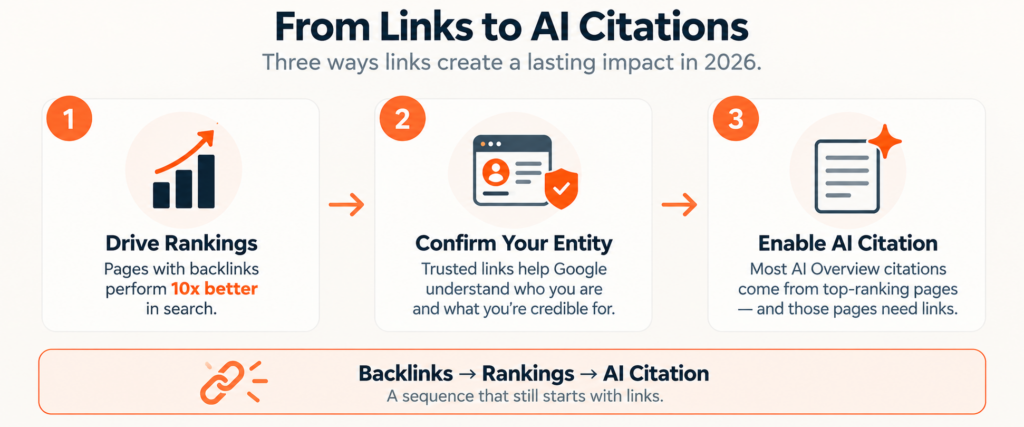
Links in 2026 build the trust and authority that let you rank and get cited. Their function has matured into three clear jobs:
- They still drive rankings
Pages with at least one backlink perform 10x better in organic search than pages with none, per Ahrefs, and referring domains hold the strongest ranking correlator of any factor studied.
- They confirm your entity
When trusted sites reference and link to your brand, Google becomes more confident in who you are and what you are credible for. This feeds the Knowledge Graph and strengthens your Brand SERP. It is where entity SEO and link building meet.
- They open the door to AI citation
Ahrefs found 76.1% of AI Overview citations come from top-10 ranking pages, and those pages need links to rank.
The path runs from backlinks to rankings to AI citation, a sequence that still starts with links. This is the clearest sign of link building importance holding firm even as search changes.
What Links No Longer Do
Links no longer work as a volume game, and this is the hardest habit for old-school SEOs to drop. Three tactics that once worked have quietly stopped:
- Raw link count
Authority now shows a threshold effect, where median AI mentions jump 3.7x between the 80th and 90th percentile of domain authority. Below the threshold, piling on links does little.
- Anchor text manipulation
Exact-match anchors have fallen out of favor industry-wide as Google’s anti-spam systems improved, making natural variation the safer default.
- Links as an AI shortcut
Backlinks alone no longer guarantee AI visibility, since they correlate at just 0.218 with AI Overview presence while brand mentions correlate at 0.664.
Anyone still asking do backlinks still matter for SEO should read this as a repricing, not an ending.
The 4 Categories of Modern Links
Not all links do the same job anymore. In 2026, they fall into four distinct classes, each with its own value and purpose. Understanding the mix is how you build a profile that actually performs.
1. Editorial Trust Links
These come from:
- Digital PR
- Journalist citations
- Tier 1 features
A placement on a genuine news publication carries authority that both Google and AI systems respect, and news sites average the highest Domain Rating at 80+. One strong feature often gets referenced by others, so the value compounds over time. This class does the heavy lifting for link building for E-E-A-T, since credible publications signal real authoritativeness.
2. Entity Confirmation Links
Sources: directories, industry associations, verified profiles.
Value: low per link, though stable and foundational.
Job: reinforcing your entity graph.
These tell Google your brand exists, operates in a specific field, and matches the details it already holds. Every fintech, SaaS, or local brand needs a clean base of them before chasing anything fancier.
3. Topical Support Links
These are guest post links placed on real, active websites within your industry that already have genuine visitor traffic.
They stay valuable when placed with intent. And they lose value fast when bought at volume. A guest post on a site your buyers actually read passes relevance and referral traffic together. This is where a vetted guest post marketplace adds real value: by taking on the heavy lifting of finding and verifying sites with genuine traffic, saving you from wasted placements.
4. Discovery Links
This includes community threads, forums, and podcast citations. Their value is second-order, and it works like this:
- They drive direct referral traffic
- They spark conversations that lead to further coverage
- They seed the brand signals AI systems weigh
Nofollow status barely matters here, since nofollow and dofollow perform almost identically for AI visibility. These links quietly support link building for AI search by spreading mentions across the web.
What the Data Says About Links in 2026
The numbers tell a clearer story than any opinion, so here is what the 2026 studies actually show. They settle the links vs content SEO debate with evidence.
Where links still win (traditional rankings):
- Referring domains lead every ranking correlation, sitting at 0.255, the strongest single correlator measured across Ahrefs’ study
- The #1 result carries 3.8x more backlinks than positions #2 through #10
- Only 2.2% of all content earns links from multiple domains, so even a few quality links stand out
Where mentions take over (AI search):
- Branded web mentions correlate with AI Overview visibility at 0.664, against 0.218 for backlinks, per Ahrefs’ 75,000-brand study
- Brands in the top 25% of web mentions earn 10x more AI Overview appearances than the next quartile
Two findings that shape planning:
- Authority works as a threshold, with roughly 50 referring domains acting as a tipping point below which AI citations stay rare
- Being cited pays, since brands inside an AI Overview earn 35% more organic clicks than uncited brands at the same position
In a nutshell, links get you over the authority bar, and mentions plus content decide what happens after.
Budget Reallocation for 2026
The data points to a clear reallocation of where the authority budget should go this year. Here is how the smart money is moving.
| Budget Line | Direction | Why |
| Digital PR | Up | Editorial trust links compound and earn AI citations |
| Programmatic guest posts | Down | Site reputation abuse enforcement raises the risk |
| Brand PR | Up | Brand mentions now correlate strongest with AI visibility |
| Marketplace niche edits | Steady | Cost-efficient topical support with real relevance |
| Content refresh | Up | Fresh content lifts AI Overview eligibility |
The logic is simple. Editorial trust links and brand mentions carry the most weight in an AI-first landscape, so they deserve more budget. Volume tactics that once padded a link count now carry penalty risk, so they deserve less. Topical support through vetted niche edits stays steady because it delivers relevance at a sensible cost.
This is what link building 2026 budgets should reflect.
How Link Building Interacts With AI Overviews
Link building supports AI Overview visibility indirectly by building the entity confidence that AI systems reward. The connection is real, and it works through a chain. Understanding AI Overviews and backlinks together is what separates brands that get cited from brands that stay invisible.
AI platforms cite sources they trust as entities. Backlinks reinforce those entity claims, telling the system your brand is credible on a topic. Structured data layered on top strengthens the effect, since pages combining schema and strong authority appear far more often in AI answers. The result is a compounding loop where links, mentions, and structure feed one another.
Four practical tactics follow from this:
- Reclaim your unlinked brand mentions and turn them into links
- Secure Tier 1 citations through digital PR
- Publish original data that others cite, since original visualizations are citation magnets
- Keep key pages fresh, because AI Overview content changes roughly every two days and rewards recency
Your 2026 Link Strategy Starts Here
Links moved from primary rank driver to trust and entity infrastructure, and that reframing should shape every authority decision you make this year. They still matter, deeply, and they now work as one part of a system that includes mentions, entities, and fresh content.
So, this quarter, do three things.
- Audit your referring domains against the roughly 50-domain authority threshold.
- Shift budget from volume guest posting toward digital PR and brand mentions.
- Then reclaim the unlinked mentions you already earned, since those are the fastest authority wins available.
To strengthen your profile with relevant, high-traffic placements, Link Publishers handles the vetting and connects you directly with real industry sites. Talk to a strategist today to discuss link building for SEO strategy that fits how search actually works.
Frequently Asked Questions
Yes. Referring domains remain one of the strongest ranking correlators at 0.255 in Ahrefs’ study. Modern link building now builds the trust and entity signals that help you rank and get cited, so it stays essential, though its role has shifted from primary driver to authority infrastructure.
Backlinks still matter, and pages with at least one backlink perform 10x better in organic search than pages without. Their weight has dropped to roughly 13% of algorithm influence, yet they remain the most important single factor you can directly measure and improve.
Link building supports AI Overviews indirectly. Backlinks help pages rank, and 76.1% of AI Overview citations come from top-10 ranking pages. Links also reinforce entity confidence, and brand mentions correlate more strongly with AI visibility, so the two work best together.
Backlinks act as a threshold condition for LLM citations. They help you clear the authority bar to be considered, around 50 referring domains. Past that point, brand mentions, co-citations, and content structure do most of the work deciding whether ChatGPT or Perplexity cites you.
Links signal the authoritativeness and trust in E-E-A-T. Editorial links from credible publications tell Google your brand is respected in its field, which strengthens how quality systems judge your content. They work alongside author credentials and cited sources.
Read Next: