Broken Link Building : The Updated Playbook

Explore this post with:
Search engines release major core updates every few months. When they do, entire content strategies fall apart overnight. They can cause traffic losses so severe that companies must pivot, restructure, or fold completely.
In the aftermath, pages get deleted, and thousands of valuable outbound links turn into dead 404s. Broken link building is the tactic that turns those dead ends into backlinks for your site.
The process is simple. You find a dead link on a relevant page, you offer your own live page as the replacement, and the site owner swaps it in. Two things happen:
- They fix a problem on their site
- You earn an editorial link
It is one of the oldest tactics in SEO, and it still works in 2026. However, in the AI era, some things have changed.
What Broken Link Building Is (And Is Not)
Broken link building means finding a dead outbound link on someone else’s page, then suggesting your live page as a replacement that genuinely fits.
The tactic is not finding any 404 and shoving your homepage into the gap. That is the fastest way to get ignored. You must understand what the dead page used to do, then offer the closest match you have.
This approach remains a classic white-hat technique because the link is earned editorially. Site owners update their pages because your link solves a real problem for their readers. A winning broken link building strategy depends on 95% relevance and 5% polite communication.
A solid workflow has four parts:
- Find the dead link on a relevant page
- Work out what the missing page actually contained
- Build or pick the closest replacement you have
- Reach out to the right person with a short, useful note
Get those four right and the tactic runs itself. Skip any one of them and your reply rate falls off a cliff.
Does Broken Link Building Still Work in 2026?
Yes, and the reason is simple: the web loses pages faster than anyone can fix them. A Pew Research Center study on link rot found that 25% of all webpages that existed between 2013 and 2023 are gone. Over 20% of live news and government pages contain dead links, and 54% of Wikipedia pages have at least one broken citation.
Every broken link sits on an active, indexable page with high authority. The original writer included that link to help their readers. That need remains, even though the destination page vanished.
Hence, this tactic works because you fix an existing problem for the site owner. You lead with a solution instead of asking for a favor. This leads to higher response rates than standard cold outreach.
However, the strategy fails when your replacement content lacks depth. Editors quickly spot a weak alternative. So a successful campaign relies on offering an exact, high-quality match.
Finding such matches is the easy part with the right tool. Link Publishers’ free Broken Link Checker crawls any prospect page and flags its 404s and dead redirects in seconds. Hence, you can spot a genuine broken-link opening before you invest time in the pitch.
The 4-Step Workflow for Broken Link Building
Step 1: Find Broken Pages Worth Pursuing
You need to find dead pages that still have active websites linking to them. Here are four easy ways to find them:
- Competitor Backlinks (Ahrefs or Semrush)
Enter a competitor’s domain into Ahrefs or Semrush, then filter the report for pages returning a 404 error. This gives you a list of their dead URLs along with every site still linking to them. It is the fastest approach because those sites have already shown interest in your topic.
- Resource Pages (Google Search)
Look for lists of helpful links in your industry using searches like site:.edu “your topic” “resources”. These pages rarely get updated, so they often contain dead links.
- Screaming Frog
Run a target domain through Screaming Frog to perform a deep crawl. This method scans every outbound link on a single website, helping you find broken external resources in bulk.
- Browser Extensions
Install simple tools like Check My Links to highlight dead links on a web page instantly.
Filter your list before starting outreach. Focus on dead pages that sit on authoritative domains with steady organic traffic, and look for dead URLs with multiple referring sites. A single broken link backed by 30 referring domains gives you 30 outreach prospects from a single find.
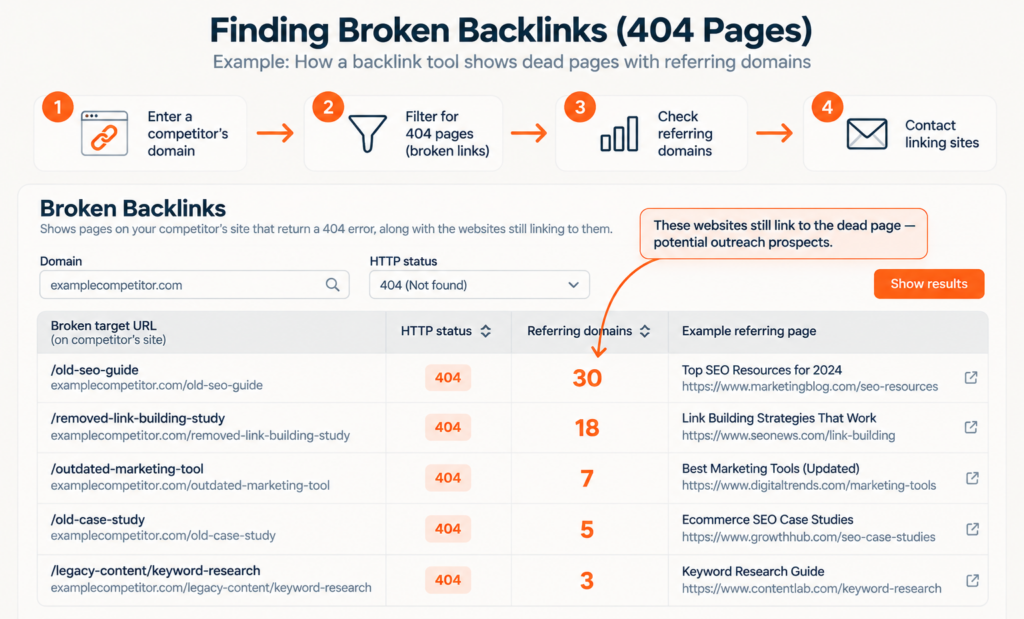
How to find broken links at scale comes down to this move: find one dead asset with backlinks, then prospect everyone still pointing at it.
Step 2: Understand What the Dead Page Was, Then Match It
Do not pitch anything until you know what the missing page actually contained. Open the dead URL in the Wayback Machine and look at the archived version.
Successful campaigns align with three specific criteria:
- Topic: Ensure your replacement covers the exact same subject matter.
- Format: Align the structure of your content with the original. Provide a checklist if the dead page was a checklist, or a tool list if it was a directory.
- Promise: Match the depth and intent of the original link. Offer a simple introductory overview if the original link served as a basic definition.
Matching all three criteria makes the editor’s job easy. Also, you can create a dedicated piece of content if you lack a suitable replacement, or skip the outreach entirely. Pitching a poor match damages your reputation with that site owner.
Step 3: Find the Right Contact
Send your pitch to the right person to get results. Contact potential leads in this order:
- The Author: Pitch the writer directly. They created the content, have direct access to edit it, and convert at the highest rate.
- The Editor: Reach out to the site’s editor if the author works freelance or cannot be reached.
- The Generic Inbox: Use general email addresses like info@ or editor@ as a last resort. These contact points often yield replies when direct options are unavailable.
Find and verify email addresses using tools, then confirm the person’s current role on LinkedIn. Log every verified address in your sheet to prevent bounced emails from damaging your domain reputation.
Step 4: Pitch With a Short, Polite Email
The email is where most campaigns fall apart, usually because it reads like a mass-sent template.
- Keep it short and specific
- Name the exact page and the dead link
- State plainly that it is broken
- Offer your replacement without demanding anything back
What to include:
- The broken URL
- The specific anchor text or link that is dead
- Your suggested replacement with one line on why it fits
AI-Assisted Prospecting in 2026
Mind you, an AI-generated pitch will not get you much further; editors filter generic AI emails in seconds. Rather, you should focus on the slowest part of this tactic, i.e., checking whether each replacement is a credible match. That is exactly what an LLM is good at.
Here is a workflow that genuinely saves hours:
- Export your broken-link prospects from Ahrefs or Semrush as a CSV, including the dead URL, the linking page, and the anchor text.
- Pull the archived content of each dead page from the Wayback Machine, even just the title and first paragraph.
- Batch-classify fit with an LLM. Feed it the dead page’s details and your candidate replacement, then ask it to score the match.
A prompt that works:
“Here is a dead page’s title, URL, and archived summary. Here is my replacement page’s title and summary. Score the match from 1 to 10 on topic, format, and reader intent. Flag any mismatch in format (for example, the original was a checklist and mine is an essay). Give one sentence on whether this is worth pitching.”
AI broken link prospecting handles the filtering. Run that across 100 prospects, and you get a ranked shortlist in minutes instead of an afternoon.
Before you pitch the shortlist, run each linking page through Link Publishers’ free Link Analyzer. It shows you the page’s live links, their status, and whether they are dofollow or nofollow, so you can confirm the dead link is genuinely broken and check that the page still passes real authority.
Realistic Success Rates
Set clear expectations to avoid wasting time. A well-researched campaign typically yields one link placement for every 15 to 25 pitches.
Key trends define these results:
- Resource Pages: These pages convert better than in-article links because their entire purpose is pointing to helpful tools.
- Government and Educational Sites: Sites ending in .edu and .gov respond frequently, though edits often take months during routine site updates.
- Direct Contacts: Reaching the author directly doubles conversion rates compared to sending pitches to general support inboxes.
- Quality Over Quantity: Sending 50 targeted pitches delivers better results than sending 500 automated emails, which often trigger spam filters.
Use your first campaign as a testing phase. Track which content types earn approval, then refine your strategy for the next round.
Pitch Templates
Keep every template short, personalize at least one line, and never paste an essay. Three that reflect how editors reply in 2026:
Template 1: Author-direct
Subject: Broken link on your [article title] piece
Hi [Name],
I was reading your article on [topic] and noticed the link on “[anchor text]” now goes to a dead page.
If you want a replacement, we recently published [your title] at [URL]. It covers the same [checklist / guide / data], so it should slot in cleanly for your readers.
Either way, thought you’d want to know.
[Your name]
Template 2: Editor fallback
Subject: Dead link in [article title]
Hi [Name],
Quick heads-up: the article at [URL] has a broken outbound link on “[anchor text].”
We have a current page that covers the same ground at [URL], if a replacement is useful. No worries if not.
Thanks,
[Your name]
Template 3: Resource page curator
Subject: A couple of dead links on your [topic] resources page
Hi [Name],
I was using your resources page at [URL] and found a few links that no longer resolve, including “[anchor text].”
One of them pointed to a [type of resource]. We publish a current version at [URL] that would fit the list. Flagging the others below so you can clean them up either way.
[list the other dead links]
[Your name]
That last touch, flagging the other dead links you found whether or not they use yours, is what turns a cold email into a genuine favor.
When Broken Link Building Is Not the Right Tactic
Broken link building is slow and hands-on. So it is the wrong tool in a few situations. Being honest about them saves you from forcing it.
- When you need link volume fast. This tactic earns links in a trickle. If you have a launch in three weeks, a marketplace or niche edits will move quicker.
- When your topic has few linked resources. Some niches simply do not have many citation-heavy pages to mine.
- When your replacement content is thin. If you do not have a genuine match and cannot justify building one, the pitch will not land.
For those cases, pairing broken link building with faster tactics gives you a balanced month. You run the slow, high-trust broken-link work in the background while filling volume through a vetted guest post marketplace or niche edits.
Link Publishers is built for exactly that pairing, whether you run it yourself or hand it to a strategist.
Turn Link Rot Into a Repeatable System With Link Publishers
Broken link building rewards discipline over hustle. A tight process, a real Wayback Machine check on every prospect, and a genuine match will out-earn any blast of 500 generic emails. Done steadily, it compounds, because each campaign teaches you which formats win the easiest links.
The smartest approach pairs it with speed. Keep the broken-link work running for high-trust editorial links, and cover your volume through a marketplace when a campaign needs pace.
You can explore the Link Publishers marketplace to fill the gaps broken link building leaves, or build a managed plan that runs both together. The web will keep breaking. You may as well turn that into links.
FAQs
Broken link building is finding a dead outbound link on a relevant page, then offering your own live page as a replacement. The site owner fixes their broken link, and you earn an editorial backlink. It works best when your page genuinely matches what the dead one covered.
Yes. The web keeps losing pages, with a quarter of all webpages from 2013 to 2023 now gone, so dead links are everywhere. Because the pitch leads with a fix rather than a request, reply rates run higher than cold guest post outreach.
A well-researched campaign typically earns one placement for every 15 to 25 pitches. Resource pages convert higher than in-article links, and pitching the author directly roughly doubles your odds compared with a generic editor inbox. Claims above 10% across the board are unrealistic.
Ahrefs or Semrush to find dead pages and their referring domains, the Wayback Machine to see what the dead page contained, Screaming Frog for full-site crawls, Check My Links for quick page checks, and Hunter for finding contacts. The Wayback Machine is the one step you cannot skip.
Pull the competitor’s backlink profile in Ahrefs or Semrush, then filter for pages returning a 404 status. Each dead page shows the domains still linking to it, which become your prospect list. Verify each link is genuinely dead before adding it.
Yes, and it suits SaaS well. Educational and resource pages in tech niches cite heavily, so dead links are common. A strong guide or tool on your site makes an easy replacement, which is why broken link building for SaaS scales into a repeatable system.
In case you missed!