








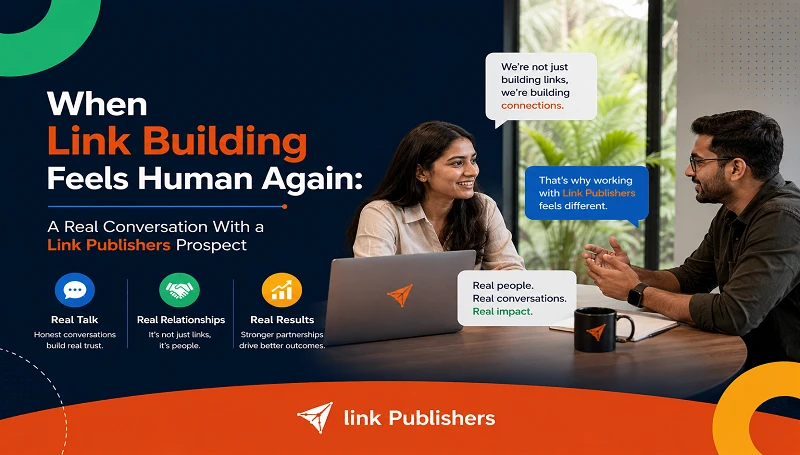
When Link Building Feels Human Again: A Real Conversation With a Link Publishers Prospect

Explore this post with:
We recently got on a call with a prospect who was exploring link building for his site. It started like most first calls do, going over goals and expectations, but it ended up being a good example of something we believe in strongly: outreach works better when it doesn’t feel automated.
Most link-building conversations live entirely in email threads and platform dashboards. A request goes in, a report comes out, and nobody ever actually talks. So when he agreed to hop on a live call with our team, he admitted he wasn’t quite prepared for it.
“Honestly, I never imagined we’d actually connect on a call like this. I thought it’d all just stay over email or the platform.”
If you’ve spent any time working with link-building vendors, you’ve probably felt some version of the same thing. You submit a request, you get a report back, and somewhere in between there’s a faceless process you just have to trust. So when a real person picks up the phone, it stands out. It shouldn’t have to, but it does.
It actually started even before the call properly began. Early on, unprompted, he brought up how much he liked using the platform itself.
“Frankly speaking, the platform is really clean and user-friendly. Very easy to get around and very intuitive to get what I want. I didn’t expect it to be this seamless.”
That’s the kind of feedback you can’t get from a feature list or a pitch deck. It only shows up when a product has actually made someone’s day easier, and this one came up before we’d even gotten into the real conversation.
How the Rest of the Call Went
The tone from the start was direct and collaborative, no scripts.
“I hope you’ll be building enough links so we can have a conversation that’s more fruitful and order-oriented, you know?”
We told him plainly: budget would move that day, and requests would go in to start building links by the weekend.
He’d already done real homework of his own: a shortlist of 50 to 60 potential domains for backlinks. Instead of just taking the list and running with it, we offered something extra: to go through it ourselves, at no cost, and narrow it down to the 15 to 20 domains that would actually move the needle for his SEO. He was glad to take us up on it.
No pressure, no upsell, just a straightforward offer to save him from paying for placements that wouldn’t matter. This is usually the moment in a first conversation where trust either starts building or it doesn’t. Here, it clearly did. And it’s not really about this one list of 60 domains. It’s about what happens any time a vendor is handed something a client has already put effort into. Do you build on that effort, or do you quietly override it?
The Moment It Turned Personal
Toward the end of the call, something shifted. The conversation stopped being purely transactional and started feeling like two teams getting to know each other.
“I guess we’ve concluded the call. Let’s stay connected. Do you have WhatsApp, or any other way to reach you besides email?”
We said that worked, and numbers were exchanged on the spot.
What could’ve stayed a cold, dashboard-only relationship turned into something with actual people attached to it, and that’s really the shift worth paying attention to. It’s not specific to this one call. It’s what happens any time someone walks in expecting a platform interaction and instead leaves with a plan, a point of contact, and the sense that someone’s actually paying attention.
Why This Matters, Beyond This One Call
It’s easy to assume that in an industry built on dashboards, reports, and bulk domain lists, the human element doesn’t matter much. This call is proof it does, and the pattern holds regardless of which client or which list of domains you’re talking about. A few things stood out:
- A free filtering offer builds instant trust. Reviewing a client’s domain shortlist and handing back a curated list costs us nothing but time, but it tells them we’re invested in their results, not just their order.
- Picking up the phone changes the relationship. A single live call can do more for trust than weeks of back-and-forth messages. It’s what turns a vendor relationship into a partnership.
- Frictionless follow-up matters. Offering a second channel like WhatsApp alongside email means a client isn’t stuck waiting on a reply buried in an inbox.
None of this requires a bigger platform or a fancier pitch. It just requires treating the first conversation like a conversation, not a transaction.
Challenges He Raised, and What We Recommended
Toward the end of the call, the conversation turned practical. He had real questions about timing and process, and we walked through them together.
“I’ll move some money and start the process today. Then, more than likely by the weekend, I’ll put in requests to start building links.”
We told him that worked, and that in the meantime we’d take the filtering off his plate. He didn’t need to worry about the domain list that night.
“I’ll probably be looking to pick up or purchase things sometime tomorrow, or Thursday morning my time.”
No rush on our end, we said. Anytime within the week worked fine for us.
That back-and-forth mattered more than it might seem. He was managing budget and schedule at the same time, and he wanted the domain review done thoroughly, not just quickly. Our advice was simple: if you want a quick win, don’t compromise on quality for the sake of hitting a deadline. A short wait for a genuinely strong list is worth it over a fast list that doesn’t hold up. He agreed, and that alignment, both sides comfortable with getting it right rather than getting it done fast, is what made the process feel relaxed rather than transactional.
Curious what a real conversation with our team looks like before you commit to a single link? Let’s get on a call.