








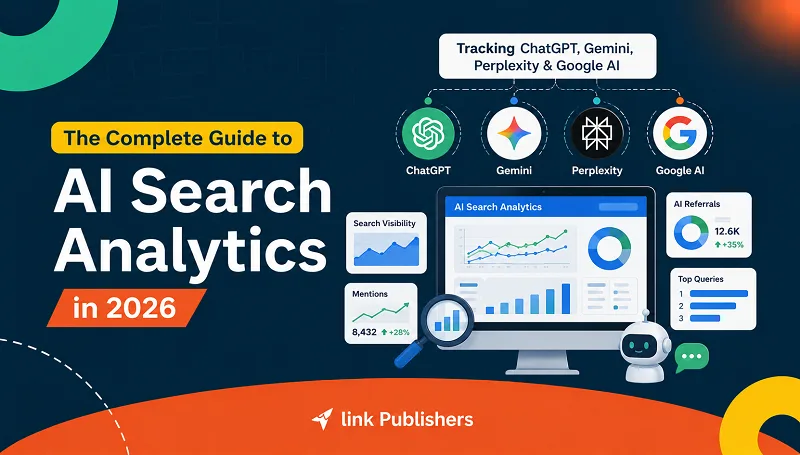
The Complete Guide to AI Search Analytics in 2026: Tracking ChatGPT, Gemini, Perplexity & Google AI

Explore this post with:
AI search analytics is the process of measuring traffic, citations, brand mentions, and visibility across AI-powered search platforms. You need it because traditional SEO reporting no longer captures the full picture of how users discover your brand.
Search behavior has changed fundamentally. Users now ask ChatGPT for product recommendations. They use Perplexity for research queries. Gemini handles conversational searches inside Google’s ecosystem. BrightEdge’s 2025 research found AI Overviews appearing in 84% of high-volume informational queries.
Here is the problem. Your website might receive 50 visits from ChatGPT monthly. But your brand could be mentioned 500 times across AI-generated answers. Traditional analytics captures only the 50 visits. AI search reporting captures both the traffic and the visibility.
This guide covers how to track AI traffic in GA4, use Google’s brand-new AI performance reports in Search Console, measure citations and brand mentions, and build dashboards that show the complete picture.
What Is AI Search Analytics?
AI search analytics measures how users discover and engage with your brand through AI-powered search platforms. This includes ChatGPT, Gemini, Perplexity, Claude, and Google AI Overviews.
Traditional SEO analytics and AI SEO analytics measure fundamentally different things.
| Traditional SEO Analytics | AI Search Analytics |
| Keyword rankings | AI visibility and citations |
| Organic clicks | AI referral traffic |
| Search impressions | AI-generated recommendations |
| Click-through rate | Brand mention frequency |
| Sessions and pageviews | AI citation growth |
Why AI Search Analytics Matters in 2026
Google launched its AI Mode earlier this year. ChatGPT Search now handles millions of queries daily. Perplexity processes research queries with source citations. Each platform generates visibility for brands that traditional ranking reports cannot capture.
On June 3, 2026, Google launched dedicated AI performance reports inside Search Console. That move confirmed what SEO teams already suspected. AI search visibility is now a measurable, reportable metric. It is no longer theoretical.
AI Search Traffic vs AI Search Visibility
This distinction matters more than most marketers realize. AI search traffic and AI search visibility are two completely different metrics.
AI Search Traffic is the actual visits arriving from AI platforms. You can count these in GA4. A user clicks a ChatGPT citation and lands on your site. That is traffic.
AI Search Visibility is how often your brand appears inside AI-generated answers. A user asks Perplexity about the best link building platforms. Your brand gets cited in the answer. The user reads the recommendation but never clicks. That is visibility.
| Metric | Traffic | Visibility |
| Visits to your site | Yes | No |
| Citations in answers | No | Yes |
| Brand mentions | No | Yes |
| Product recommendations | No | Yes |
| Measurable clicks | Yes | No |
| Influence on buying decisions | Direct | Indirect |
Many brands earn hundreds of AI citations before they see significant AI referral traffic. Visibility builds trust over time. Traffic follows once users encounter your brand across multiple AI-generated answers.
How to Track AI Traffic in GA4
Can Google Analytics 4 Track AI Traffic?
Yes. GA4 records visits from AI platforms as referral traffic. However, GA4 does not provide a dedicated AI traffic report. You need to find AI visits within your referral data manually.
GA4 automatically records visits from ChatGPT, Perplexity, Gemini, and Claude when those platforms pass referral data. Not all AI platforms pass referral headers consistently. Some visits may appear as direct traffic instead.
Where to Find AI Traffic in GA4
Navigate to this path inside GA4:
Reports > Acquisition > Traffic Acquisition
Set the dimension to “Session Source / Medium” and search for these referral sources:
| Platform | Referral Source |
| ChatGPT | chatgpt.com / chat.openai.com |
| Perplexity | perplexity.ai |
| Gemini | gemini.google.com |
| Claude | claude.ai |
| Copilot | copilot.microsoft.com |
Create a Custom AI Channel Group
Most agencies are now creating a dedicated “AI Search” channel group inside GA4. This separates AI traffic from general referral traffic in your reports.
How to set it up:
- Go to Admin > Data Display > Channel Groups
- Create a new channel group called “AI Search”
- Add conditions: Source contains “chatgpt” OR “perplexity” OR “gemini” OR “claude” OR “copilot”
- Save and apply to your reports
This gives you a clean, dedicated view of all AI-generated traffic in one place. Client reporting becomes significantly easier when AI search has its own channel.
How to Track ChatGPT, Gemini, Perplexity & Claude Traffic Separately
Most competitor guides lump all AI traffic together. That approach misses important platform-level insights.
| Platform | Referral Source | Typical User Intent | Traffic Quality |
| ChatGPT | chatgpt.com | Research and recommendations | High engagement, longer sessions |
| Perplexity | perplexity.ai | Discovery and fact-checking | Highly qualified, strong intent |
| Gemini | gemini.google.com | Search and exploration | Growing volume, mixed intent |
| Claude | claude.ai | Professional research | Smaller volume, B2B-heavy |
Why Platform-Level Tracking Matters
ChatGPT traffic tends to have higher engagement rates because users actively sought a recommendation. Perplexity referrals often convert better because the platform cites specific sources that users trust. Gemini traffic is expected to grow significantly as Google expands AI Mode across more search queries.
Track each platform separately inside GA4 using source filters. Compare engagement rates, conversion rates, and session duration across platforms. This data helps you understand which AI platform drives the most valuable visitors.
Building AI Traffic Reports in GA4
Agencies need structured AI search dashboards for client reporting. Here is what to include.
Recommended Metrics for Your AI Dashboard
| Category | Metric | Why It Matters |
| Traffic | AI sessions by platform | Volume tracking |
| Engagement | Engagement rate from AI sources | Quality assessment |
| Conversions | Goal completions from AI traffic | Business impact |
| Revenue | Revenue attributed to AI referrals | ROI measurement |
| Growth | Month-over-month AI traffic change | Trend tracking |
Compare AI Traffic vs Organic Traffic
Build a side-by-side comparison showing how AI search traffic performs against traditional organic search. Many SEO teams are finding that AI referral visitors spend more time on site and convert at comparable or higher rates than organic visitors.
The real value of this comparison is client education. When clients see AI traffic growing alongside organic traffic, they understand why AI search optimization matters for their business.
How to Track AI Search Performance in Google Search Console
Google launched its Generative AI performance report inside Search Console on June 3, 2026. This is the first time Google has provided dedicated AI search visibility data to website owners.
What the New Report Shows
The report tracks how often your pages appear inside Google’s AI-generated features:
- AI Overviews (AI-generated answers at the top of search results)
- AI Mode (Google’s full conversational AI search experience)
- Generative AI features in Discover
Available data dimensions include:
| Dimension | What You Can See |
| Pages | Which URLs appeared in AI features |
| Countries | Geographic breakdown of AI visibility |
| Devices | Desktop, mobile, or tablet |
| Dates | Performance trends over time (hourly, daily, weekly, monthly) |
What the Report Does Not Show (Yet)
The current report shows AI search impressions only. It does not include click data, CTR, average position, or query data. Google stated that additional metrics will be added over time. The data starts from May 18, 2026.
This report is currently rolling out to a subset of websites, starting with UK-based properties. Wider availability is expected after the testing phase.
Why This Changes Everything
Before June 2026, SEO teams relied on third-party tools to estimate AI visibility. Google then launched dedicated Generative AI performance reports inside Search Console on June 3, 2026. For the first time, website owners can see first-party AI impression data directly from Google.
This makes AI search performance a reportable metric alongside traditional search performance.
Measuring AI Citations and Brand Mentions
Traffic tells you who clicked. CitatiBrand Mentions for SEO: The Complete Guide to Building Authorityons tell you who trusted your content. AI citations occur when platforms like ChatGPT, Perplexity, or Google AI reference your brand, article, or website as a source.
Why Citations Matter
AI search platforms tend to cite the same trusted sources repeatedly. More citations generally indicate stronger authority, trust, and topical expertise within your niche. A brand mentioned across 50 Perplexity answers has significantly more AI presence than one with zero mentions.
Tools to Monitor AI Brand Mentions
| Tool | What It Tracks |
| Google Alerts | Brand name mentions across the web |
| Brand24 | Real-time brand monitoring with sentiment |
| Ahrefs Brand Radar | Brand mention growth and context |
| Semrush Brand Monitoring | Competitive mention analysis |
| Manual AI queries | Search your brand directly in ChatGPT, Perplexity, Gemini |
Run your brand name through each AI platform monthly. Ask product-related questions your customers would ask. Note whether your brand appears in the generated answers. Track this consistently over time.
AI Search KPIs Every SEO Team Should Track
| KPI | What It Measures | Where to Find It |
| AI referral traffic | Visits from AI platforms | GA4 referral reports |
| AI impressions | Visibility in Google AI features | GSC AI performance report |
| Citation frequency | How often AI cites your content | Manual monitoring + tools |
| Brand mention growth | AI awareness of your brand | Brand monitoring tools |
| AI conversion rate | Business impact of AI traffic | GA4 conversion reports |
| AI visibility share | Your presence vs competitors | Manual competitive analysis |
Track these KPIs monthly. Report them alongside traditional SEO metrics. Clients and stakeholders need to see that AI search monitoring is producing measurable business outcomes.
How Backlinks Influence AI Search Visibility
AI search platforms do not just evaluate content. They also assess authority, trust, and how widely your brand is cited across the web.
Backlinks for AI search serve a dual purpose. They strengthen your Google rankings while increasing the probability that AI systems cite your content.
| Link Type | AI Visibility Impact |
| Editorial guest posts | Build topical authority that AI systems recognize |
| Digital PR mentions | Generate brand signals AI platforms scan for |
| Contextual niche edits | Strengthen page-level authority on specific topics |
| Resource page links | Support domain-level trust signals |
AI search ranking backlinks do not create AI traffic directly. They increase the likelihood that AI systems trust, cite, and recommend your content in generated answers.
Recommended AI Search Analytics Tools in 2026
| Tool | Best Use Case | Pricing |
| Google Analytics 4 | AI traffic tracking and conversion measurement | Free |
| Google Search Console | AI search impressions and visibility trends | Free |
| Ahrefs | Backlink monitoring and competitive analysis | Paid |
| Semrush | Competitor AI SEO analytics and brand tracking | Paid |
| Brand24 | Real-time AI brand mentions monitoring | Paid |
| Looker Studio | Custom AI search dashboard building | Free |
Common AI Search Analytics Mistakes to Avoid
- Tracking only AI traffic while ignoring visibility. Many brands earn citations long before they receive significant clicks. Visibility growth often precedes traffic growth.
- Ignoring brand mentions in AI-generated answers. Even without clicks, AI recommendations influence purchasing decisions and future branded searches.
- Not monitoring citation frequency. You need to know whether AI platforms are citing your competitors more often than your brand.
- Treating AI search like traditional SEO. AI search introduces citations, recommendations, and entity-level visibility that ranking reports do not capture.
- Skipping backlink and authority signals. AI systems prefer trusted, well-cited sources. Authority backlinks directly influence citation probability.
- Not measuring business impact. Track leads, conversions, and revenue from AI traffic. Visits alone tell an incomplete story.
The Future of AI Search Analytics
Search is shifting from a keyword-to-ranking model toward a question-to-answer-to-recommendation model. This changes what SEO teams need to measure.
Google’s new AI performance report is just the beginning. Expect AI impressions, AI clicks, and AI visibility metrics to become standard Search Console features within the next 12 months. Future tools will likely measure citation frequency and recommendation rates the same way we track rankings today.
Entity SEO is gaining traction because AI systems understand brands, not just keywords. Brands that consistently appear across AI-generated answers will compound that advantage over time. AI search analytics will become a standard KPI in every SEO report by 2027.
Start Tracking Your AI Search Performance Today
AI search analytics is broader than referral traffic alone. To understand your full AI search performance, you need to monitor traffic, visibility, citations, brand mentions, and conversions together.
GA4 measures visits. Google Search Console now measures AI search impressions. Citation and mention tracking measure authority. Together, these give you a complete view of how AI-powered search is affecting your business.
The brands that start measuring AI search properly now will identify opportunities earlier and build competitive advantages that become harder to replicate over time. Explore Link Publishers to build editorial backlinks that strengthen both your Google rankings and your AI search visibility across ChatGPT, Gemini, Perplexity, and Google AI.
FAQS
AI search analytics is the process of measuring traffic, citations, brand mentions, and visibility across AI platforms like ChatGPT, Gemini, Perplexity, Claude, and Google AI. It goes beyond traditional SEO reporting to capture how AI systems discover and recommend your brand.
You can track AI traffic in GA4 through referral reports. Navigate to Reports > Acquisition > Traffic Acquisition. Filter by sources like chatgpt.com, perplexity.ai, gemini.google.com, and claude.ai. Create a custom “AI Search” channel group for cleaner reporting.
Yes. Google launched its Generative AI performance report in Search Console on June 3, 2026. The report shows impressions for AI Overviews, AI Mode, and Discover AI features. Click data is not included yet.
AI traffic measures actual visits from AI platforms to your website. AI search visibility measures how often your brand appears in AI-generated answers, including citations and mentions where users may never click.
AI SEO backlinks from authoritative, niche-relevant publishers build the trust and authority signals that AI systems use to identify which brands to cite in generated answers. More editorial mentions increase your citation probability across ChatGPT, Perplexity, and Google AI Overviews.