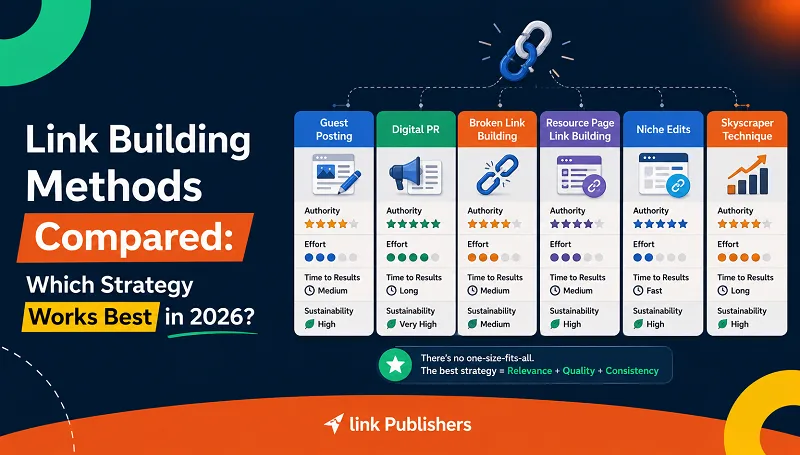









High-Authority Backlinks: How They're Earned (Not Faked)


Explore this post with:
If you’re buying links, using link exchanges, or sending out 50 cold emails a day hoping for a 2% response rate, you already know it’s not working. Your rankings aren’t moving. Traffic’s flat. And you’re burning time you don’t have.
High-authority backlinks don’t come from outreach templates or paid placements. They come from sites linking to you because your content is actually useful to their audience.
The math is simple: one link from a relevant, trusted site beats 100 links from random blogs nobody reads. Google’s algorithm prioritizes quality over quantity, and genuinely authoritative sites only link to content that serves their readers.
So how do you actually earn these authority links? Let’s break down what actually works.
What “Authority” Actually Means Now
Real authority in Google’s eyes means your site is a trusted source in a specific topic, validated by other trusted sources consistently referencing you.
Authority is no longer domain-wide but topical. Search Engine Land has authority on SEO topics. If they started publishing gardening articles, those pages would not carry the same weight because they have not built authority in that area.
Google evaluates authority through entity recognition and topical graphs. Some real authority indicators Google tracks:
- Consistent citations from other recognized authorities in your space
- Expert authors with credentials and publication history
- Original research, data, or insights others reference
- Being mentioned alongside other established authorities
- User behavior signals showing people trust and engage with your content
You can’t fake this with metrics, because it relies on years of consistent, high-quality publishing and genuine citations.
That same structure now matters for AI and LLM visibility.
AI systems don’t evaluate every page independently. They learn which sources are reliable by observing who gets cited consistently, by whom, and in what context. Sites that show up repeatedly in authoritative discussions become part of the trusted knowledge base AI draws from.
| The telltale signs Google uses to spot fake authority:Site links to completely unrelated industries (finance, health, tech, and gambling all on one blog)No consistent topical focus or expertiseSudden influx of outbound links to commercial sitesContent quality is inconsistent or obviously boughtSite accepts “guest posts” or “sponsored content” from anyone who pays |
How Authority is Actually Earned
Here’s what earning high-authority backlinks actually looks like in practice:
1. Publish original research and data
The fastest way to earn authoritative backlinks is by creating data that doesn’t exist anywhere else. When you’re the only source for specific information, everyone writing about that topic needs to cite you.
Survey 200 customers about a specific pain point. Analyze 1,000 data points from your industry. Track a trend over 6 months that nobody else is monitoring. Publish the findings with proper methodology. Pitch it to industry journalists as exclusive data.
What makes research link-worthy:
- Data that answers questions people are actively asking
- Statistically significant sample sizes (not 20 responses)
- Clear methodology that builds trust
- Visualizations that make data shareable
- Surprising or counterintuitive findings that challenge assumptions
2. Become a quoted expert source
Journalists need expert sources for their articles. Position yourself as that expert, and you’ll earn links from publications that actually matter.
How this works:
Sign up for platforms like HARO (Help A Reporter Out), Qwoted, or SourceBottle. Journalists post queries looking for expert commentary. You respond with genuinely helpful insights and they quote you in their articles, linking to your site.
Keys to getting quoted:
- Respond within 2 hours (journalists work on tight deadlines)
- Provide specific, quotable insights, not generic fluff
- Include relevant credentials that establish expertise
- Don’t pitch your product unless specifically relevant
- Build relationships with journalists who cover your beat
3. Create industry-standard resources
Build something so useful that it becomes the go-to resource everyone references. This requires significant upfront effort but pays dividends for years.
Examples of resources that earn authority:
- Comprehensive guides that answer every question on a topic (10,000+ words with depth)
- Calculators or tools that solve specific problems (ROI calculators, comparison tools)
- Industry reports published annually that track trends over time
- Frameworks or methodologies that others can implement
- Curated databases or directories that aggregate scattered information
| Example: Moz’s Beginner’s Guide to SEO has earned thousands of backlinks because it became the standard resource people reference when explaining SEO basics. They invested heavily in making it comprehensive, accurate, and accessible. Now it ranks for hundreds of keywords and earns links passively. |
What makes a resource link-worthy:
- Solves a problem completely, not partially
- Updated regularly to maintain accuracy
- Better than any alternative by a significant margin
- Free and accessible without gates
- Designed for sharing (clear structure, visuals, quotable sections)
4. Contribute genuine expertise to established publications
Strategic guest posting still works. But only when you’re contributing real expertise to publications your target audience actually reads, not just any site that accepts guest posts.
Contributing an expert piece to Harvard Business Review or your industry’s leading trade publication about a trend you’re seeing builds authority. Getting published on “marketingblogsubmissions.com” does nothing.
The difference between authority-building and spam:
| Authority-building guest posting | Spam guest posting |
| – You pitch tier-1 publications in your industry with specific article ideas – They have strict editorial standards and reject most pitches – You write original insights based on your expertise, not regurgitated SEO content – The publication’s audience genuinely benefits from your knowledge – Links are natural and contextual, not forced author bio links | -Sites with “Write For Us” accepting anything 500+ words – No editorial review or quality standards – You write generic content just to get a link – Site covers unrelated topics and accepts everyone – Value is entirely in the author bio link |
5. Build relationships before you need links
The most powerful backlinks come from genuine professional relationships, not cold outreach. Here’s how to build industry relationships:
- Engage thoughtfully with other experts’ content (not generic “great post!” comments)
- Share others’ work with your audience when it’s genuinely valuable
- Collaborate on research, webinars, or content projects
- Contribute to industry discussions without self-promotion
- Attend (virtual or in-person) industry events and network authentically
When you’ve built real relationships, mentions happen naturally. Someone writing an article remembers your research. A peer includes you in a roundup of industry experts. A journalist who knows your work reaches out for commentary.
6. Leverage newsjacking and timely expert commentary
When something significant happens in your industry, be the first with expert analysis.
Set up Google Alerts for key topics in your space. When breaking news hits, publish analysis within hours, not days. This positions you as a go-to expert source and earns links from news coverage and industry commentary.
How to execute:
- Monitor industry news constantly
- Have templates ready for rapid publishing
- Focus on analysis and implications, not just reporting what happened
- Reach out to journalists covering the story, offering an expert perspective
- Publish on your blog and pitch to industry publications simultaneously
7. Create link-worthy visual content and data visualizations
Original visual content (infographics, interactive tools, custom research visualizations) earns links because:
- They simplify complex information
- They’re easily embeddable on other sites with attribution
- They get shared on social platforms, increasing visibility
- They demonstrate investment in quality content
- They’re harder to replicate than text
What works:
- Interactive calculators (loan calculators, ROI tools, comparison matrices)
- Original data visualizations showing trends over time
- Process diagrams explaining complex workflows
- Infographics that aggregate research from multiple sources with proper citation
- Charts and graphs from your original research
The Long Game: Building Sustainable Authority
Real authority is never built in 30 days. It’s built the same way reputation is built in any serious industry: through consistent, high-quality work over months and years.
The sites that dominate competitive search results aren’t the ones that bought the most links last quarter. They’re the ones that invested early in real expertise, published resources people needed, and earned trust long before Google rewarded them for it.
Here’s what the timeline really looks like:
| Timeline | What happens |
| Months 1-3 | Publish foundational content, clarify your expertise, and start building relationships. Don’t expect meaningful links yet. |
| Months 4-6 | First authority mentions appear from consistent quality and targeted outreach. Early trust signals form. |
| Months 7-12 | Momentum builds. You start earning 5–10 real links per month without chasing them aggressively. |
| Year 2+ | Authority compounds. Links come passively as your work becomes a default reference in the space |
What Not to Do to Earn High-Authority Backlinks (Even If It Looks Like It’s Working)
While earning high-authority backlinks is about doing the right things, it also means avoiding practices that appear successful in the short term but hurt credibility over time:
1. Buying links on “real” sites with hidden networks
Some paid links look legitimate on the surface: real domains, decent traffic, clean design. But behind the scenes, many of these sites are part of private networks monetized through outbound links. These sites:
- Link out across unrelated industries
- Reuse the same anchor structures
- Publish content at unnatural velocity
- Exist primarily to pass link equity
Google is very good at identifying these patterns over time. The links may work briefly, then quietly stop passing value. Or worse, pull your site into a low-trust neighborhood.
2. Scaling guest posts with recycled ideas
Guest posting breaks the moment it becomes a volume play.
When the same “10 trends,” “ultimate guide,” or surface-level advice gets rewritten across dozens of blogs, nothing new is being contributed. Editors might accept it. Readers ignore it. Google discounts it.
Scaled guest posts fail because:
- There’s no original insight to validate expertise
- The content doesn’t earn engagement
- Links exist for SEO, not value
Remember: One strong, insight-driven article on a respected publication beats 50 forgettable guest posts every time.
3. Over-optimizing anchor text for control
Exact-match anchors feel powerful because they’re measurable and controllable. They’re also one of the fastest ways to signal manipulation. This is because real authority doesn’t need anchor control. It earns links because the surrounding content makes sense, not because the anchor was planned.
Natural links use:
- Brand names
- URLs
- Contextual phrases that make sense in the sentence
When a backlink profile leans too heavily on keyword-rich anchors, it stops looking like editorial choice and starts looking engineered.
4. Chasing DA instead of relevance
Domain Authority is a third-party metric. Google doesn’t use it. A DA 80 site that barely touches your topic is often less valuable than a DA 30 site deeply embedded in your niche.
Links help when they:
- Reinforce your topic cluster
- Come from sites your audience already trusts
- Sit inside content that’s genuinely related
5. Treating traffic spikes as authority gainsTraffic spikes feel validating. But authority is measured by trust and repetition.
Viral posts, trending keywords, or temporary news coverage can drive traffic without building lasting authority. If those visitors don’t return, cite, or engage deeply, the spike fades and nothing compounds.
Authority shows up when:
- Your pages keep earning links months later
- Other writers reference you without prompting
- Rankings hold through algorithm updates
The Authority Mindset Shift
Stop thinking about backlinks as transactions you buy. Start thinking about them as byproducts of being genuinely useful to your industry.
Every authoritative backlink you’ve earned tells a story: someone found your work valuable enough to tell their audience about it. That’s not something you can fake with a credit card. It’s something you earn through expertise, consistency, and creating resources that genuinely move your industry forward.
The shortcuts will always be tempting. The packages promising 50 high-DA links for $2,000 will always exist. But they’ll also always fail because they’re optimizing for the wrong thing.
So, build authority the hard way. Create research worth citing. Develop expertise worth quoting. Build relationships worth maintaining. Publish resources worth bookmarking.
Related content
)







Why Every Brand and Agency Struggles With Link Building - And How Li...
Entity SEO: How Strategic Link Building Builds Entity Authority in 2...