








How to Build High-quality Backlinks in 2026: (What to Do, What to avoid)


Explore this post with:
A marketing agency spent $12,000 building backlinks for its client over four months. They acquired 43 links from sites with solid domain metrics and clean spam scores. Rankings didn’t budge.
Then the client’s CEO was quoted in an industry trade publication article. No outreach, no payment, just 15 minutes answering a journalist’s questions. That single mention moved their primary keyword from position 18 to position 7 in three weeks.
Same website. Same niche. Completely different results.
The expensive backlinks had all the “right” metrics: domain authority, organic traffic, and proper indexing. The journalist’s mention came from a smaller publication with lower traditional SEO metrics. Yet only one actually influenced rankings.
So, what’s separating links that work from links that waste budget? That’s exactly what this guide discusses.
How do you build high-quality backlinks in 2026?
In 2026, the best backlinks are built by focusing on relevance, editorial intent, and real usefulness, not just by looking at numbers.
This is what the best way to do things looks like today:
- Don’t start with domain authority; start with topic fit.
- Get links from pages that already get traffic or rank well.
- Put links in places that make the content more useful.
- Don’t use forced keywords; use natural, descriptive anchors.
Backlinks that help people learn about a subject become more valuable over time.
Backlinks made just to change rankings lose their value over time.
Core Features of High-Quality Backlinks in 2026
The difference between a backlink that moves your rankings and one that wastes your time comes down to specific, measurable characteristics:
1. Topical relevance over domain metrics
Domain Authority means nothing if the site isn’t in your industry.
When a cybersecurity blog links to your security software, Google understands the connection: both sites exist in the same topical ecosystem. That relationship signals genuine endorsement. But when a general news site links to the same product, there’s no logical reason unless it’s paid placement.
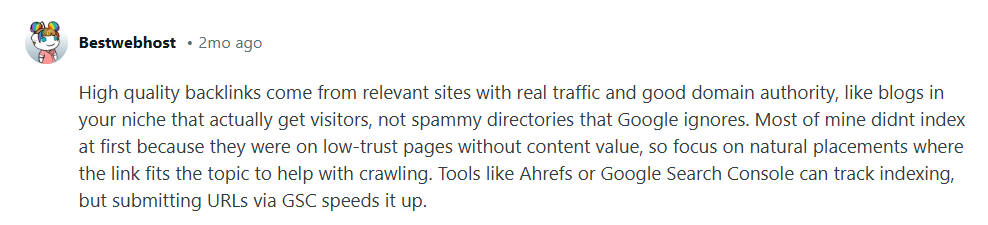
What Google checks:
- Does the linking site regularly publish content in your industry?
- Is the specific page discussing the same topic as your page?
- Are other sites linked from that page also in your niche?
| Example of good relevance | Example of poor relevance |
| You sell accounting software for small businesses. You get mentioned in AccountingToday’s article “Cloud Accounting Tools CPAs Recommend in 2026.” The page discusses bookkeeping, tax compliance, and financial reporting. Your link sits alongside mentions of QuickBooks and Xero. | Same accounting software gets mentioned in a lifestyle blog’s article about “productivity hacks” alongside links to meditation apps, standing desks, and meal prep services. |
2. Editorial placement within main content
Google’s algorithms analyze the text surrounding your link (called “link context”). They evaluate whether the link makes sense in the narrative flow. A link that interrupts the reader’s experience or feels forced is discounted. Also, links buried in footers, sidebars, or author bios pass minimal value.
| Example of a valuable link | Example of a worthless link |
| BuzzFeed publishes “11 Productivity Tools Remote Teams Actually Use in 2026” and mentions your project management software in paragraph 4: “Notion alternatives like [YourTool] have gained traction because they integrate directly with Slack, eliminating the constant tab-switching that kills productivity.” | The same mention, but stuck in a “Recommended Resources” box at the bottom of an unrelated article about email marketing templates. |
3. The linking page gets real traffic
A link from a page nobody reads passes zero value.
Google uses actual click data as a quality signal. If a page gets traffic and people engage with it (low bounce rate, time on page), links from that page carry more weight. It’s Google’s way of validating that real humans find the content valuable.
How to verify: Use Ahrefs or SEMrush to check estimated traffic to the specific page (not just the domain). A page getting 500+ monthly visitors is decent. Under 50 monthly visitors? Probably worthless.
4. Author expertise and E-E-A-T signals
Google’s algorithms now identify and weight content by specific authors, especially in YMYL (Your Money Your Life) categories like finance, health, and legal. In fact, it has built author entity graphs that track expertise across the web.
How this plays out in practice:
- Link from Dr. Andrew Huberman’s article about sleep supplements → High value for health products
- Link from “Staff Writer” on the same health site → Minimal value
So, check the author:
- Do they have credentials listed?
- Have they published on other authoritative sites?
- Does their LinkedIn show relevant expertise?
- Is there even a byline, or is it “Admin” or “Guest Post”?
5. Natural link velocity pattern
Legitimate content earns a few links in the first month, slightly more in the second as it gets discovered, then builds momentum over time as more people reference it. But getting 50 backlinks in one week, then nothing for three months, triggers Google’s spam filters immediately.
| Natural growth pattern | Unnatural pattern that gets flagged |
| – Month 1: 3-5 new referring domains- Month 2: 4-7 new referring domains- Month 3: 6-10 new referring domains (as content gains traction organically)- Month 6: 15-20 new referring domains (content reaches critical mass) | – Month 1: 47 new referring domains (you bought a package)- Month 2: 2 new referring domains- Month 3: 1 new referring domain– Month 4: 0 new referring domains |
When you buy bulk link packages, the pattern is obvious: massive spike, then nothing. Google’s algorithms are specifically designed to catch this because no genuine piece of content earns 47 backlinks on day one and then goes silent.
6. Diverse link profile
All your backlinks coming from guest posts? Red flag. All from press releases? Red flag.
Google expects variety because naturally successful content gets referenced across different platforms and contexts. If 90% of your links are guest posts with identical patterns, the algorithm spots the manipulation instantly.
A healthy backlink profile includes:
- Editorial mentions (30-40%)
- Resource pages and curated lists (15-20%)
- Industry directory listings (10-15%)
- Guest contributions on relevant sites (10-15%)
- Customer testimonials and case studies (5-10%)
- Forum and community mentions (5-10%)
- Social media profiles (5-10%)
The mix reflects genuine discovery and varied use cases. If every link follows the same template (800-word guest post, author bio link, published on “Write For Us” sites), Google sees the pattern.
7. The link uses natural anchor text
Your anchor text distribution tells Google whether you’re manipulating rankings or earning links naturally.
Toxic anchor text profile:
- 65% “best project management software”
- 18% “project management tool for teams”
- 12% “top PM software 2026”
- 5% brand name or URL
Natural anchor text profile:
- 50-60% brand name (“Asana,” “Monday.com,” “YourBrand”)
- 20-25% naked URLs (https://yoursite.com)
- 10-15% generic (“click here,” “this tool,” “check it out,” “read more”)
- 5-10% partial match (“their project tool,” “this platform”)
- Only 5% exact match commercial keywords
Why this matters: When 70% of your anchors are commercial keywords, Google knows you’re manipulating rankings. I’ve seen sites penalized for this exact issue: entire pages deindexed, not just dropped in rankings.
8. The website has clean technical health
Links from sites with technical issues pass less value. Google evaluates the entire site’s quality, not just the linking page.
Technical factors that matter:
- Page load speed (pages loading in 2-3 seconds vs 8+ seconds)
- Mobile optimization (properly responsive vs broken mobile experience)
- Security (HTTPS vs HTTP)
- Site architecture (clean structure vs chaotic, hard to navigate)
- Crawlability (no major indexing issues)
For example, you get two links:
- Link from a well-maintained site: loads in 1.8 seconds, mobile-optimized, regularly updated content
- Link from a neglected site: loads in 9 seconds, broken mobile layout, outdated content from 2021, mixed content warnings
The first link passes substantially more value because Google trusts the entire ecosystem more.
What TO Do: Best Ways to Get High-Quality Backlinks in 2026
1. Put topic relevance ahead of authority
A DR 40 site that is very focused on your niche often does better than a DR 80 site that publishes everything.
Ask yourself this before looking at the numbers:
- Is this page about the same issue we help with?
- Would our link really help the reader?
If the content doesn’t need your link, don’t make it.
2. Make links from pages that people can see
Quality at the page level is more important than ever.
Pages that have strong backlinks:
- Get high rankings for related keywords
- Get traffic from search engines
- Have links inside them that point to them
- Don’t make pages just to hold outgoing links.
Quick check: If the page doesn’t have any rankings, traffic, or internal links, the backlink probably won’t help.
3. Put links where a reader really needs them.
“In-content” alone isn’t enough.
There are high-quality backlinks:
- While explaining an idea
- When backing up a claim
- As a logical next step for readers
Weak links show up:
- In lists that are forced
- In paragraphs that are just there to fill space
- Where the content doesn’t need to be cited
Easy test: Take out your link.
If the paragraph gets weaker, the link is good. If nothing changes, the link will have little effect.
4. Use natural anchor text (stop over-optimizing)
In 2026, using exact-match anchors on a large scale is dangerous.
What works:
- Names of brands
- Some phrases
- Descriptions of nature
Things to stay away from:
- Using the same keyword anchor on different sites
- Anchors that are written for bots instead of people
Rule: Anchors should not rank, they should explain.
5. Look at how the site links to other sites.
This is one of the quality filters that people miss the most.
Don’t go to sites that:
- Link to industries that aren’t related
- Publish sponsored posts all the time
- Make money from links aggressively
Sites that give you high-quality backlinks usually:
- Choose your links carefully
- Explain why a resource is helpful
- Don’t sell each paragraph
Google doesn’t trust anyone if a site links to everyone.
6. Pay more attention to editorial links than link placements.
The best backlinks for 2026 are:
- Editorial mentions
- References in context
- Updates to the content of existing articles
Backlinks that aren’t as strong come from:
- Guest posting on a larger scale
- Articles that are templates
- Write for us” farms
This change is why a lot of SEO teams now use editorial-first publisher ecosystems instead of just doing manual outreach.
We at Link Publishers, make it easier to find publishers who put links in a way that makes sense and is intentional, not just because they have to.
7. Use the “LLM Test” Before You Approve a Link
Just ask this simple question:
Would an AI system be sure that this page is a source?
If the page:
- Is thin
- Mostly there for links
- Doesn’t know what they’re doing
…it probably won’t do well in models that use AI for discovery.
More and more, high-quality backlinks come from content that is worth citing.
What Link-Building Methods Should You Stay Away From in 2026?
Certain link-building practices that may have worked in the past are now reducing a link’s value to near-zero or making it actively harmful:
1. Private Blog Networks (PBNs)
PBNs are networks of sites built solely to sell links, often using expired domains to fake authority. Google detects these through:
- Shared hosting IPs
- Identical Google Analytics codes
- Similar site templates
- Unnatural interlinking patterns that make no editorial sense
These networks may appear legitimate on the surface, but Google’s spam team has developed sophisticated detection systems.
When multiple “different” sites share the same technical footprint or link to the same set of clients in patterns that don’t reflect genuine editorial choice, the algorithm flags them.
2. Low-quality guest posting farms
Sites with “Write For Us” pages accepting articles on marketing, finance, health, pets, travel, and technology are link farms.
These sites have:
- Zero editorial standards
- Publish anything over 500 words
- Exist only to sell author bio links
- Accept everyone who submits
This results in wildly inconsistent quality and random topic coverage.
The giveaway is sites claiming expertise in everything from cryptocurrency to dog training to wedding planning. No legitimate publication covers that range. These links pass minimal value at best and can trigger spam filters when you have too many from similar sources.
3. Paid links disguised as editorial content
When a site suddenly publishes an article praising your product despite never mentioning you before, and that article sits alongside dozens of similar “reviews” for unrelated products, the algorithmic flags go up.
Google tracks which sites monetize through link sales by analyzing their linking patterns over time. Sites that link to completely different industries month after month, always with glowing reviews, are obviously selling placement.
Getting caught with paid links that pass PageRank can result in manual penalties that devastate your organic visibility for months.
4. AI-generated thin content
Sites publishing 20+ AI-generated articles per day are easy for Google to identify. These sites show clear patterns: generic writing, repetitive phrasing, no author credentials, and unrealistic publishing velocity. They exist to scale content, not to inform readers.
Google’s spam classifiers discount links from these sites to near zero. Worse, repeatedly earning links from known AI content farms can weaken your site’s trust signals through guilt-by-association.
FAQ : High-Quality Backlinks in 2026
Yes, but only if they are relevant to the topic and placed well in the editorial. Having a high DR alone doesn’t mean you’ll have an impact.
There isn’t a set number. Most successful SEO teams don’t care about how many links they get; they care about how many high-intent links they get.
Paid links that don’t make sense to editors lose value quickly. Paid placements only work when they look like real editorial references.
No. Even though they don’t pass PageRank, nofollow links can still bring in visitors, boost brand awareness, and build trust, especially when they’re used in the right way.
How SEO teams are getting more high-quality backlinks 2026?
Teams that win aren’t building more links.
They’re building:
- Fewer
- Better
- Context-First links
That’s why a lot of people now use managed link building services that focus on quality, editorial fit, and long-term trust instead of just the number of links.
If you’re thinking about this method, check out our High-Quality Backlink Services to see how relevance-first acquisition works.
The Future of Backlink Quality
The backlinks that actually move rankings in 2026 share the same DNA: they come from topically relevant sources, appear naturally in content people actually read, use normal anchor text, and exist because an author genuinely believed their audience would benefit.
Everything else is wasted effort or active harm.
Google’s algorithms have evolved past simple metrics. They evaluate context, author expertise, user engagement, and dozens of other signals that separate real endorsements from manufactured ones.
So, focus your energy on creating resources that industry peers want to reference naturally. Build real relationships with other creators in your niche. Contribute genuine expertise where your audience already gathers. That’s how you earn backlinks that actually matter and rankings that last.
Also read:
The Hidden Ranking Factor You Can’t Ignore
Global SEO Leaders Explain How AI Is Breaking Traditional SEO Signals
Backlinks and the AI Visibility Curve
The Next Big SEO and Revenue Opportunity for Publishers
)