Entity SEO: How Strategic Link Building Builds Entity Authority in 2026

Explore this post with:
If you’ve been keeping half an eye on SEO news this year, you’ve probably noticed something. Every second article talks about “entities” now. Not keywords. Entities.
That shift didn’t happen overnight. But in 2026, it became impossible to ignore. Google’s core updates this year, in March and again in May, rewarded something specific – sites with clear, recognizable identities. Not pages stuffed with the right phrases, but brands AI systems could actually trust and point to.
So what changed? Search stopped being about matching words on a page to words in a query. It became about recognition. Does Google know who you are? Does it know what you’re an authority on?
That’s entity SEO. And one of the oldest tools in the toolbox, link building, turns out to be one of the strongest ways to build that recognition. Not in the old “more backlinks equal higher rankings” way. In a more strategic way, which is what we’ll unpack here, through this entity SEO guide.
What Is Entity SEO?
Let’s start simple. An entity is any distinct “thing” in Google’s eyes – like a person, brand, company, product, or place. It’s something with its own identity, not just a web page.
Think of it this way: a keyword is just text. “Best CRM software” is a keyword. But Salesforce is an entity. It has a history, mentions across websites, and a presence on different platforms. Google doesn’t just see it as a word. It understands it as a real thing.
This understanding comes from Google’s Knowledge Graph, which maps how different entities are connected. When your brand is mentioned alongside trusted sources or credible websites, it strengthens your presence in that map.
Some common examples of entities include people, brands, products, and places.
Here’s the key point: you can’t simply claim to be an entity. Google recognizes you as one based on how consistently and credibly you appear across the web. And that’s where link building plays a big role.
Why Entity Authority Matters in AI Search
ChatGPT, Gemini, Perplexity, and Google’s AI Mode don’t read pages the way a traditional crawler does. They’re trying to answer a question directly, so they need to know which sources to trust. Google said this plainly earlier this year – optimizing for AI search is still SEO. There’s no separate playbook. The same things that build trust for regular rankings are what AI systems rely on when deciding who to cite.
And AI Mode isn’t small anymore. It crossed a billion monthly users this year, and usage keeps doubling every few months. People aren’t typing three-word searches into it either. They’re asking long, specific questions, almost like talking to a knowledgeable friend. That matters, because content built around short keyword phrases doesn’t match what people are actually asking anymore.
So how do these systems decide who to trust? Mostly through entity recognition. If your brand keeps showing up in credible contexts – cited by publications, mentioned by trusted sites – that consistency signals you’re a real, established presence, not just a page that happened to rank once.
Entity SEO vs Traditional SEO
| Entity SEO | Traditional SEO |
| Built around entities | Built around keywords |
| Goal is recognition | Goal is ranking |
| Backlinks as trust signals | Backlinks as votes |
| Builds brand identity | Optimizes individual pages |
| Targets AI search and search engines | Targets search engines |
Traditional SEO isn’t dead. It’s just no longer the only story. A page can rank without the brand behind it having real authority. But that’s getting harder to pull off, especially after the May 2026 update, where sites simply compiling information lost visibility while destinations with genuine depth gained ground.
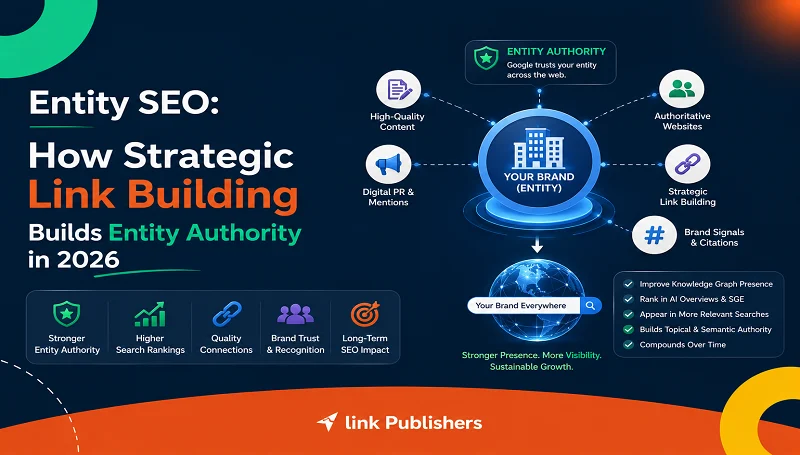
How Strategic Link Building Builds Entity Authority
Link building didn’t stop mattering. It changed jobs. It used to be about passing a bit of ranking power from one page to another. Now, its real value is in what it signals about your entity.
When a credible, relevant site links to you, it’s vouching for your brand as a whole, not just a page. Do that consistently across trusted sources, and you build co-citation. Your brand gets mentioned near other established names in your field, even without a link, every time.
Editorial backlinks, the kind you earn rather than request, tell search engines your content was genuinely useful. Contextual links, placed naturally within relevant content, reinforce what your entity is actually about. And when a high-trust domain links to you, some of that trust transfers, telling algorithms you belong in that conversation.
One good link from a relevant publication is fine. Twenty, spread across months, from sites that actually cover your industry, starts to look like the kind of entity that deserves a Knowledge Panel someday.
The Best Link Building Strategies for Entity SEO
Not every link-building tactic contributes equally to entity authority. Some are built for it. Others, frankly, aren’t worth the effort anymore.
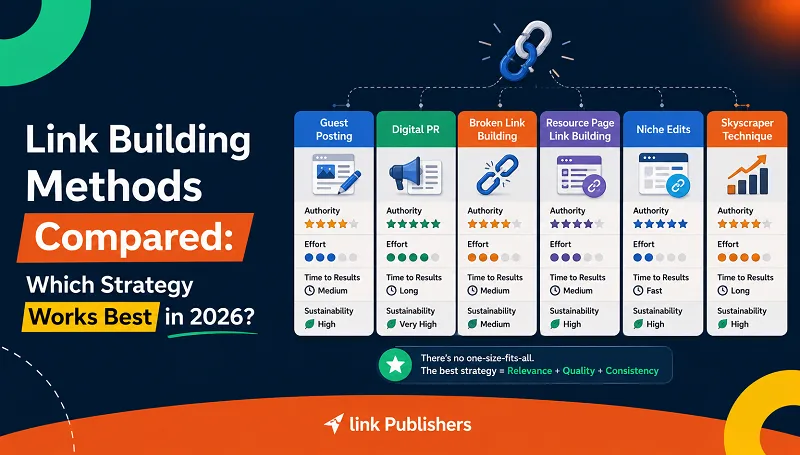
Guest Posting
Done right, guest posting puts your name and expertise in front of an audience that already trusts the host site. The value isn’t really the backlink itself – it’s the association. Write for a site your industry actually reads, and you’re borrowing a bit of their credibility while also getting discovered by new people.
Digital PR
This is probably the most underrated lever for entity building right now. Getting covered by a journalist, quoted in an industry roundup, or featured in a press piece does something guest posts can’t – it creates third-party validation. Nobody paid for that mention. It happened because you had something worth reporting on.
Niche Edits
Sometimes called curated links. Your link gets added into a piece of content that’s already published and already ranking. Done on a genuinely relevant page, it carries a lot of topical weight without needing anything new to be written.
Editorial Links
These are the links you don’t ask for – they show up because someone found your resource valuable enough to reference on their own. They’re rare, but they’re the strongest signal you can get, since there’s zero commercial framing behind them.
Resource Pages
Getting listed on a well-maintained “best of” page in your niche gives you steady, easy visibility, and keeps reinforcing topical relevance over time.
Brand Mentions
Here’s something a lot of people miss – you don’t always need a hyperlink for a mention to count. Google’s systems are increasingly capable of recognizing unlinked brand mentions as a trust signal too. If your brand name keeps popping up across the web, even without a link attached every time, that’s still data feeding the entity graph.
| Strategy | Builds Authority | AI Trust | Scalability | Difficulty |
| Guest Posting | High | Medium | Medium | Medium |
| Digital PR | Very High | High | Low | High |
| Niche Edits | Medium | Medium | High | Low |
| Editorial Links | Very High | Very High | Low | High |
| Resource Pages | Medium | Low | Medium | Low |
| Brand Mentions | High | High | Medium | Medium |
Beyond Backlinks: Other Signals That Strengthen Entity Authority
Link building is one piece of the puzzle, not the whole picture. A few other things matter just as much, and honestly, a lot of brands skip these entirely.
Structured data is the technical foundation here. Organization Schema tells search engines exactly who you are – your name, logo, social profiles, the works. Author Schema does the same for the people writing your content, which matters a lot more now that Google is explicitly rewarding named, credible authors over generic “editorial team” bylines. SameAs Schema links your entity across platforms (your LinkedIn, your Wikipedia entry if you have one, your other verified profiles), helping Google connect the dots between all the places you exist online.
Wikidata is worth a mention too. It’s a lesser-known but genuinely useful way to formally register your entity in a structured, machine-readable database that AI systems often pull from directly.
Then there’s the more human side of it. Consistent brand information across every platform – same name, same description, same details, no contradictions. Author expertise that’s actually visible and verifiable, not just claimed. And E-E-A-T as a whole, which by now most SEOs know stands for experience, expertise, authoritativeness, and trust – the four things Google’s quality raters are trained to look for.
How AI Search Uses Entities
When someone asks ChatGPT or Google’s AI Mode a question, the system isn’t randomly picking a source to quote. It’s running entity recognition in the background, checking which sources it associates with credibility on that specific topic.
That’s why AI citations have become such a hot topic this year. Recent industry data suggests that pages actually cited inside an AI Overview see more clicks than a standard top organic result – even though overall click-through on AI-heavy queries has dropped.
Recommendation engines work the same way. An AI shopping assistant or a tool helping someone compare vendors, relies on entities they already trust. Hence, brands with strong, consistent entity signals show up more often in AI answers, even over brands that are technically well-optimized but have no real presence beyond their own site.
How to Measure Entity Authority
This is the part that confuses people, because entity authority doesn’t show up as one clean metric in Search Console. You’ve got to look at a handful of signals together.
Branded search volume is a strong starting point. Are more people searching for your company name directly over time? Brand mentions, both linked and unlinked, tell you how often you’re being talked about across the web. Referring domains and editorial links show the breadth and quality of who’s vouching for you. AI citations, while harder to track precisely right now, are worth watching manually. Search your own brand or service category inside AI Mode occasionally and see if you show up.
Knowledge Panel visibility is the clearest sign you’ve “made it” as an entity in Google’s eyes, though it’s not something you can force; it’s earned. And don’t ignore the basics either: organic visibility and direct traffic, tracked over months rather than days, since entity building is genuinely a slow-burn process.
Common Entity SEO Mistakes
A few patterns we see over and over with brands getting this wrong.
Chasing link quantity over quality: A few good-quality links are much better than a lot of low-quality links.
Ignoring brand consistency: If your business name or description is even slightly different across ten platforms, Google struggles to connect the dots.
Building backlinks from irrelevant sites: A high “DA” score doesn’t help much if the site has nothing to do with your industry.
Missing structured data: A huge number of sites still don’t have basic Organization Schema set up, which agencies feel is not important.
Weak author profiles: Generic bylines, no verifiable credentials, no external presence are becoming more of a liability with every core update.
No Digital PR strategy at all: This means you are missing out on some of the strongest trust signals available right now.
Entity SEO Checklist
Before you wrap up any entity-based SEO push, run through this:
- Organization Schema implemented correctly
- Author Schema on every piece of content
- SameAs links connecting your profiles across platforms
- An active Digital PR effort, even a modest one
- Guest posts placed on genuinely relevant, authoritative sites
- A steady flow of editorial backlinks, not just a one-time push
- Brand mentions tracked, even unlinked ones
- Consistent branding across every platform you’re on
- Strong internal linking that reinforces topical depth
- Some form of AI Search monitoring, even manual spot-checks
Bringing It All Together
Entity SEO optimization isn’t replacing link building; it’s making strategic link building more important, because links remain one of the clearest ways to build the recognition Google and AI systems now reward. The brands that do well through the rest of 2026 will be the ones combining link building with Digital PR, consistent mentions, and genuine topical depth, not just one of these alone.
That’s exactly what we do at Link Publishers. We help businesses get the right backlinks through guest posts, niche edits, Digital PR, and strong publisher partnerships that build real authority, not just short-term rankings.
FAQs
It’s the practice of optimizing your brand’s recognition as a distinct, trustworthy “entity” in Google’s Knowledge Graph and AI search systems, rather than just optimizing individual pages for keywords.
Quality backlinks act as trust signals, showing search engines and AI systems that credible sources vouch for your brand, which strengthens how confidently you’re recognized and cited.
No. It’s building on top of it. Link building remains one of the most effective ways to establish entity trust, just with a different underlying goal.
Even unlinked mentions contribute to entity recognition, since search engines can identify and associate your brand name with relevant context across the web.
AI systems check which sources they already associate with credibility on a topic, largely based on consistent, trustworthy signals like citations, mentions, and structured data.
You can track branded search volume, referring domains, brand mentions, editorial links, AI citation appearances. Also, check Knowledge Panel visibility over a period of months.
Digital PR and genuine editorial links carry the most weight. A mix of guest posting, niche edits, and consistent brand mentions builds the strongest long-term foundation.