What is SaaS Link Building: A Complete Guide on Process, Challenges and More!

Explore this post with:
Here’s the truth about SaaS link building: all the ‘experts’ were writing this stuff for everyone else. Blogs, ecommerce stores, local services. Then someone adds ‘for SaaS’ to the headline and leaves it at that.
But SaaS is a special kind of beast: your buyers have a multi-month decision cycle. Your audience is so technical that they can tell a sales pitch from three tabs away. And the marketing tactics that drive success, like free tools and original data, require a significant investment up front.
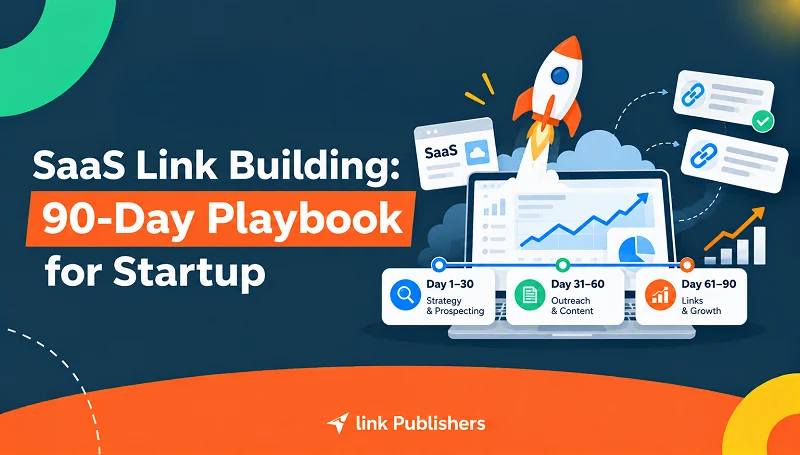
This guide is different. Rather than unloading 20 growth tactics on you and crossing your fingers, it sequences them. A 90-day plan, tailored for SaaS teams from seed to Series B. What to focus on first, what to defer, and what “success” actually means.
Grab a coffee. Let’s get into it.
Why SaaS Link Building Is Different
If you’ve done link building for other kinds of sites, forget a few things. Seriously.
The buyer journey is long. It could take someone three to nine months of “I have a problem” to “Alright, I want to buy this”. During that process they’re reading comparison pages, scrolling G2, asking in Slack communities, and googling your competitors. Your links have to appear throughout that entire spectrum, not just at the top of the funnel.
Technical audiences don’t care about your pitch. Pitch a developer-focused publication with “we’d love to collaborate!” and watch the silence roll in. These editors want something specific: new data, a useful tool, a genuinely fresh angle. Flattery gets filtered out fast.
The best assets cost money upfront. A free tool or a proper data report can earn links for years. But somebody has to build it first. That’s a hard sell when you’re a lean startup counting runway.
Review sites and comparison SERPs matter in a way they don’t elsewhere. G2, Capterra, and “X vs Y” pages are a huge chunk of how software gets chosen. A saas link building strategy that ignores them is leaving real pipeline on the table.
None of this is bad news. It just means you need a plan that fits how SaaS actually works. Which brings us to the good part.
The 90-Day SaaS Link Building Plan
Three stages. One feeds off the other. Don’t Jump to the Fun Part. Resist the urge to bypass foundation work because it makes everything that follows much easier.
Days 1-30: Foundation and Quick Wins
Month one is about collecting links that are already sitting there, waiting for you. No big launches. Just smart cleanup.
Audit what you’ve got. Pull your current backlink profile and put it next to your top three competitors. Where are they getting links that you aren’t? Which pages of theirs attract the most? You’re not copying them. You’re finding the gaps.
Reclaim unlinked brand mentions. If I had to tell you the ONE thing I want you to do in the next week, this would be it. Loads of websites already mention your brand without linking to it. Sending a short, pleasant email requesting they add a link is usually all that’s needed.
Get listed in the right directories. For SaaS, the main ones are G2, Capterra, Software Advice, GetApp, TrustRadius, Product Hunt, and SaaSHub. Their link value isn’t identical across the board, and I will dig into that a bit later. What counts now: they each place you before buyers already weighing one tool against another.
Set up your pitching channels. Sign up for Qwoted, Featured, and Help a B2B Writer. These platforms connect you with journalists who need expert quotes. Responding takes a bit of time each week, but the links come from real publications.
What to expect: somewhere around 5 to 15 easy links. It won’t feel dramatic. That’s fine. You’re laying track.
Days 31-60: Content-Led Links
Now you start making things people want to link to.
Publish one original data study. It can come from a survey of your customers or from anonymized product data. Maybe you can say something nobody else can, like how teams really use a feature, or what the average onboarding time looks like in your category. Original numbers are the thing journalists and bloggers can’t get anywhere else.
Publish one statistics page. Pick your niche and build the definitive “stats” roundup for it. People searching for numbers to drop into their own articles will cite and link to the page that makes those numbers easy to find. Keep it updated, and it keeps working.
Build one free tool. Even a simple one. A calculator, a template generator, a grader. We’ll dig into this in the next section, but know that even a basic tool can earn links for a long time after launch.
Guest post on two to four niche-relevant blogs. Aim for sites your actual buyers read. Relevance beats raw authority here.
What to expect: around 10 to 25 links, and then more as the assets compound over the following six months. This is where the curve starts bending.
Days 61-90: Digital PR and Scale
By now you’ve got assets worth promoting. Time to push them out.
Run one reactive PR campaign. Something happens in your industry (a big news story, a policy change, a competitor’s outage) and you’ve got something smart to say about it, fast. Speed is the whole game here. Journalists on deadline love a source who answers within the hour.
Pitch a proactive, data-led campaign. Take that data study from month two and turn it into a story. What’s the headline finding? Who’d care? Pitch it to the reporters who cover that beat.
Scale your guest posting. Doing this by hand gets old quickly. A marketplace or managed service can take the heavy lifting off your team, so you’re not spending every Friday hunting for contact emails.
Launch integration pages. If your product connects to other tools, give each integration its own page and tell your partners about it. They’ll often link back.
What to expect: 10 to 30 editorial links from mid-tier and smaller publishers. Not every link will be a trophy. That’s okay. Volume plus relevance is what moves the needle at this stage.
SaaS-Specific Linkable Assets
Tactics get you links. Assets get you links over and over. Here are the four that tend to work best for software companies.
Free Tools
Free tools punch way above their weight. Why? Because they’re genuinely useful, and useful things get bookmarked, shared, and linked to without anyone having to be asked.
Some ideas that work across lots of SaaS categories:
- ROI calculators. “How much could you save by switching?” Simple input, clear output.
- Template libraries. Proposals, SOPs, spreadsheets, whatever your audience keeps recreating from scratch.
- Assessment quizzes. “How mature is your marketing ops?” People love scoring themselves.
On cost: it varies a lot. A basic calculator might be a few days of developer time. A more polished tool with accounts, saving, and exports can run into weeks. Scope it small first. You can always add features after you see whether anyone cares.
One tip. Tie the tool to your product’s core problem. A random viral quiz might get links, but a tool that attracts people who’d actually buy from you gets links and leads.
Statistics Pages
Your statistics pages are link bait because content writers are always on the lookout for a number to cite. If you have the clearest source, you get the citation.
Where do the stats come from? Three places:
- Your own product data. Aggregated and anonymized, this is gold. Nobody else has it.
- Surveys. Ask your customers or run a small panel. Even a few hundred responses can give you a headline stat.
- Third-party aggregation. Take reliable published stats from sources and organize them in a friendly way, and give everyone proper attribution. A little more generic, but still the best organized out there.
Industry write-ups sometimes say these pages gain many times more links than opinion pages. I don’t want to be too specific about how many times, but the overall direction is good: stats are linked to. Opinions are not.
Integration Pages
These do double duty. For users, they answer “does this work with my stack?” For link building, they give you a natural reason to talk to partners.
Create a dedicated page for each integration. Describe its purpose, intended users, and setup process. Notify the partner after publishing. Many partners may link to your page from their marketplace, documentation, or blog, in particular if you suggest a co-marketing exchange. These cross-partner links are typically highly relevant, which is ideal.
Alternative and Comparison Pages
“[Competitor] alternatives” and “[Your product] vs [Competitor]” pages rank for the exact queries buyers type when they’re close to deciding. Great for traffic. Surprisingly good for links too, if you do them right.
The key word is honest. Don’t write a page where you win every row of the table. Readers see through it instantly, and so do editors. Say where a competitor is stronger. Explain who each tool is best for. That fairness is what makes people trust the page and cite it.
G2, Capterra, and Review Site Link Building
Review sites are weird because they help you twice. They influence rankings and they influence whether a skeptical buyer clicks “request demo.” For a lot of SaaS products, a prospect has looked at your G2 page before they’ve ever read your homepage.
Getting reviews without breaking the rules: Every platform has its own guidelines, and they’re serious about them. Don’t buy reviews, don’t give incentives that violate their rules, and don’t advise customers on what to write. The safe way is quite straightforward: politely request real, satisfied customers at an appropriate time (immediately following onboarding, renewal, or milestone), with a direct link. Familiarize yourself with each platform’s latest rules before you begin a campaign, as they’re constantly evolving.
What you get link-wise. It depends. Some review platforms give follow links on your profile, some don’t, and it can differ by plan or page type. Don’t build your whole strategy around the link attribute. The bigger win is visibility and trust, plus the referral traffic. Check the current status on each site.
A rough benchmark. Around 50 or more reviews tends to signal that a product is established. Fewer than that, and buyers may wonder whether you’re new or unproven. It’s not a magic number, but it’s a decent goal to work toward.
SaaS Link Building Benchmarks
Everyone asks “what’s a good number?” and nobody wants a vague answer. So here are some realistic guideposts. They’re rules of thumb, not guarantees. Your niche and competition will shift them.
- Seed stage: 20 to 40 referring domains in your first 12 months is a strong showing.
- Series A: 100 to 200 referring domains is a reasonable expectation.
- Series B and beyond: 300 or more.
- Domain Rating growth: gaining about 10 points a year is healthy for a post-seed SaaS company.
If you’re on the low side for these numbers, don’t fret. You should look at your real competition first. If you all have 50 referring domains in your neck of the woods, then 50 is the number to beat. And if you’re on the high end, don’t get comfortable. Links erode. Competitors close the gap.
One more thing: quality counts more than totals. Ten relevant links from sites your buyers read are worth more than fifty random ones.
Red Flags When Hiring a SaaS Link Building Vendor
At some point, most teams outsource at least part of this. That’s smart. But there’s a lot of mediocre work out there, so know what to watch for.
They don’t understand your category. Ask them to explain your product back to you. If they can’t tell your buyers from your users, they can’t pitch your story.
Their outreach is templated. Ask to see sample emails. If it reads like it could be sent to a plumber, a dentist, or a project management app, walk away. A technical editor will delete it without a second thought.
They get links from irrelevant sites. A cloud security tool earning links from a lifestyle blog isn’t helping anyone. Relevance matters to rankings and to real readers.
They can’t do data-led work. If every proposal is “guest posts, guest posts, guest posts,” they’re missing half the playbook. Good partners can support original research, free tools, and PR.
Wrapping Up
If this feels like a lot, here’s the short version.
Foundation first. Quick wins, directories, mention reclamation. Then build assets: data, a tool, a stats page. Then PR and scale, once you’ve got something worth shouting about.
That’s it. Nothing flashy. The teams that win at SaaS link building usually aren’t the ones hustling hardest in any single week. They’re the ones who keep showing up, stack assets on top of each other, and let compounding do its thing.
Start small. Pick the first thing on the list and do it this week.
Frequently Asked Questions
Begin with the simple things: review unlinked mentions, be listed on the main software directories, and build expert-quote websites. Once those are achieved, develop one or two assets to connect to (a data study, free tool, stats page) and promote using guest posts and PR. The 90-day plan above explains the timeline.
There isn’t one winner. For early-stage teams, unlinked mention reclamation and directory listings provide the quickest return. For long-term growth, original data and free tools usually earn the most over time. Most strong strategies use a mix.
You can see first links within weeks. Meaningful ranking movement usually takes several months, and compounding assets continue to pay off for a year or more. If someone promises overnight results, be skeptical.
It varies by your activity and your provider. In-house work is mostly time and tools. Free tools and original research require design and development budget. Managed services and marketplaces are paid per link or monthly retainer. Request estimates based on your real goal(s), and check out our guest post pricing report for current market ranges.
There isn’t a set value. A good measurement is earning around 10 DR points per year after the seed stage. Benchmark yourself against your direct competitors, as the correct target will differ by niche.
Original data and research, free tools, integration pages, fair comparison pages, digital PR presence on review sites, applicable guest posts. Focus on whichever will be valuable to your audience in order of importance.
In case you missed!





Choosing a Link Building Partner (Agency Buyers Guide)
Link Building Statistics 2026: 50+ Data Points Every SEO Should Know