








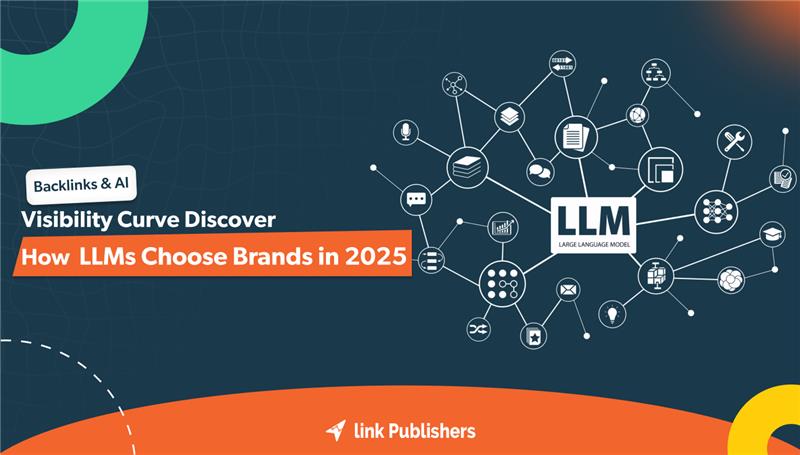
Backlinks and the AI Visibility Curve: What Link Publishers' 2025 Study Shows About How LLMs Choose Brands

Explore this post with:
We’re living through the biggest shake-up in search since Google first launched. AI tools like ChatGPT and Gemini now answer user queries directly, leaving marketers wondering: do backlinks still matter?
That’s exactly what Link Publishers set out to answer in their 2025 study.
Executive Summary
Link Publishers analyzed 500+ web pages across 20 industries to examine how backlinks influence retrieval and ranking within LLMs, such as ChatGPT, Google Gemini, Perplexity AI, and Claude.
The dataset included multiple backlink categories: editorial in-content links, guest posts, niche edits, digital PR placements, resource page links, and brand mentions. The goal? To measure their correlation with AI-powered search visibility.
The data reveal three critical findings:
- Backlinks correlate strongly with LLM ranking and retrieval.
- Pages with high link equity appear more frequently in AI-generated answers.
- Contextual links plus brand mentions significantly improve retrieval accuracy and brand visibility.
For marketers, the implication is clear: Google AI Overviews, ChatGPT Search, and other AI platforms have captured increasing market share from traditional search. So, the websites that will thrive are those building authoritative backlink profiles aligned with how LLMs evaluate and retrieve information.
Introduction
For over two decades, search worked the same way: you typed something into a search box, algorithms matched your keywords, and ten blue links appeared.
Today, that behavior is rapidly shifting toward conversational AI. Users increasingly turn to chat-based assistants (ChatGPT, Bing Chat, Gemini, etc.) for direct answers instead of scrolling through lists of links. In fact, Google’s search market share dropped below 90% in late 2024, the first dip in a decade.
These AI systems don’t simply match keywords. They understand context, evaluate source credibility, assess topical authority, and synthesize information from multiple sources to generate comprehensive responses.
This creates a new optimization challenge: Generative Engine Optimization (GEO). While SEO focuses on rankings, GEO is about gaining inclusion and prominence within AI-generated content.
That leads to the question marketers everywhere are now asking: Which signals actually influence what LLMs retrieve and display? Emerging data points to a clear answer: Backlinks aren’t just an SEO asset, they’re a critical LLM visibility signal.
This study tests that assumption.
Methodology
We conducted this study with a dataset of 500+ pages from 20 different industries, ranging from tech SaaS and ecommerce to healthcare, finance, and local business sites.
Our researchers went deep with the analysis tools:
- For link analysis: Ahrefs and Semrush gave us the comprehensive backlink data, referring domains, link types, anchor text, domain ratings, topical relevance scores, and temporal link acquisition patterns.
- For AI testing: We utilized direct API access to OpenAI’s GPT-4 and GPT-4 Turbo models, Google’s Gemini API for programmatic testing, Perplexity AI’s platform for citation analysis, and Claude for comparative retrieval patterns.
For every page, we recorded the following metrics:
- Link authority: Page-level and domain-level link strength.
- Backlink type distribution: Percentage of editorial in-content links vs. guest posts, forum links, directory links, etc.
- Anchor text profile: Breakdown of anchor types (branded, exact-match keywords, partial-match, generic “click here”, etc.).
- Topical relevance: Topical domain of linking sites (to assess the relevancy of backlinks).
- Brand mentions: Count of notable unlinked brand mentions across the web.
- LLM retrieval stats: In how many AI model answers did the page appear?
Importantly, LLM prompts were standardized. We used identical or very similar phrasing across models to reduce variability. For example, each model was asked a set of 5 related questions for each page’s topic to see if the page (or its domain) surfaced in responses.
Lastly, we created a scoring system that looked at four dimensions:
- Retrieval score: Did your page appear to be the answer? (Weighted based on how relevant the query was)
- Contextual accuracy: Was the information from the page represented correctly when included? (Scored 0-100)
- Citation frequency: How often was the page explicitly cited when its information appeared in answers?
- Repeat presence: Did you show up consistently for related queries, or was it just a one-time fluke?
The State of Search in 2025
By late 2025, all major search providers have deeply integrated AI:
- Google’s AI Overviews: Google pulls snippets from trusted sources and delivers them above traditional listings. In fact, a study revealed that Quora is the most-cited website in Google’s AI Overviews (with Reddit second).
- Microsoft Bing’s Deep Answers: Bing integrates GPT-4-powered Deep Answers, citing sources directly in conversational responses.
- ChatGPT Search: Unlike earlier versions of ChatGPT that synthesized information without attribution, ChatGPT Search explicitly cites its sources.
- Perplexity: It has built its entire platform around the citation-first model, displaying source cards alongside every answer and allowing users to directly explore referenced materials.
- Google’s Gemini: This focuses on fact-grounding and attribution, surfacing content from high-trust domains.
Here’s the common thread across all these platforms: they all reward authority, trust, contextual relevance, and brand recognition, qualities that are heavily influenced by backlinks.
This reveals that the transition to AI-powered search hasn’t diminished the importance of backlinks. It has transformed how they function and what they signal.
Marketers who get this will dominate AI search visibility. Those who keep saying “AI doesn’t care about SEO” while doing nothing about their link profiles? They’re going to wonder why they’re becoming increasingly invisible.
Backlinks in the Age of LLMs: Why They Still Matter
A persistent misconception suggests that LLMs operate independently of traditional SEO signals. And generate responses purely from training data without consideration for web-based authority indicators. This understanding is fundamentally incorrect and reveals a misunderstanding of how modern AI systems actually function.
While large language models don’t crawl the web like Google’s bots, they do prioritize content from authoritative sources. And backlinks remain one of the strongest authority signals available.
Pages with rich link profiles are more likely to be embedded in training data, selected during retrieval, or cited during answer generation.
Here’s why backlinks still matter:
- They create high-trust domains: Backlinks from credible sites act as digital endorsements. When LLMs are trained or retrieve content, they treat heavily linked pages, especially from reputable sources, as more trustworthy. A blog post on climate science with dozens of quality backlinks is far more likely to be cited than one with none.
- They reinforce topical authority (via clusters): Backlinks naturally form topical clusters. If a site gets consistent links from other cybersecurity sites, for instance, an LLM maps it into that knowledge domain. This “topical link graph” helps models retrieve contextually accurate content.
- They amplify widespread mentions (Entity signals): When your brand is linked or mentioned across multiple authoritative sites, it builds an “entity fingerprint” in the model’s memory. The more often your brand is associated with quality content, the more likely the LLM is to pull it into answers.
- They provide reliable factual grounding: High-quality backlinks often point to factual or valuable content (studies, definitions, guides). These are exactly the kinds of sources LLMs prefer to use to ground their answers.
Study Insights: Backlink Types With LLM Retrieval

The pie chart summarizes the correlation strength (as a percentage share) of different backlink types with LLM retrieval.
We analyzed the composition of each page’s backlink profile to see which link types might matter most for AI visibility. Key ones we looked at:
1. Editorial in-content links: These links appear when journalists, bloggers, or creators reference your site as a source or example within their content. Because they are surrounded by meaningful context, they help AI systems understand why it is important within a specific topic.
2. Digital PR placements: These are links from press releases, news articles, or features on media sites (earned via PR rather than purely organic editorial context). When AI systems encounter your site referenced in Forbes, TechCrunch, Business Insider, or industry-specific authority publications, they recognize this as a trust signal.
3. Guest posts: Quality guest posts often include author bios, contextual references to your expertise, and in-depth content that demonstrates domain knowledge. On highly relevant, authoritative sites, they create a richer profile for AI systems to evaluate when determining source authority.
4. Niche edits: Also called contextual link insertions, these are backlinks added to existing published articles rather than created through new content. AI systems recognize these connections when evaluating the source relevance for specific topics.
5. Resource page links: These pages act as directories of high-quality resources, and your site gets included as one of the recommended links. AI can interpret that a link from an authoritative university’s resource page or an industry association’s curated list carries more weight than a link from a generic resource directory.
6. Brand mentions (Unlinked): Even without a clickable link, repeated mentions across credible sources help LLMs identify your brand as a recognized entity within a topic. AI systems factor in how often and in what context your brand appears when determining which sources to retrieve.
7. Social signals: These include mentions or shares on platforms like X (Twitter), LinkedIn, Reddit, or Facebook. While they don’t contribute traditional link equity, they can create topical buzz and help AI systems detect trending discussions.
However, their direct correlation with LLM retrieval is low compared to editorial or PR-driven links.
Why editorial links win?
Editorial links ranked highest because they provide contextual authority, which is one of the strongest visibility signals for LLMs. When a model encounters “Page X cited by Site Y in an article about [Topic],” it gains directional information: this page is trusted for this subject.
Placement is equally important. A link inside a body paragraph discussing a specific concept gives the model clear semantic cues about why the page was cited and which topic it supports.
In contrast, sidebar, footer, or author bio links lack topical relevance, so they add minimal value in LLM retrieval.
Backlink Quality vs Quantity
Our analysis showed that quality far outweighs sheer volume when it comes to LLM visibility. A few insights:
- High-authority sources weigh the heaviest: One contextually relevant citation from a trusted domain can outperform dozens of low-quality links in driving AI visibility. This is because LLMs “count” the credibility of the source of a mention, not just the presence of a link.
- Over-optimization hurts credibility: Interestingly, pages that had signs of over-optimized link building (e.g., dozens of backlinks with identical keyword-rich anchor text, or all links coming from a single link network) did not perform well. In fact, a few such pages were never cited by the AI at all, despite having seemingly “high” backlink counts.
- Diverse, contextual links beat a high volume from one site: Our analysis noted that diverse referring domains, having backlinks spread across many different reputable sites, correlated with AI visibility more than raw link count.
Correlation Between Backlink Authority & LLM Retrieval

The bar chart illustrates that pages with higher backlink authority appear more frequently in AI-generated answers.
Our data shows a clear relationship between backlink authority and LLM retrieval frequency.
Pages that earned at least one backlink from a DR 50+ domain appeared in ChatGPT and Gemini answers far more often than those supported only by low-authority links. In fact, high-quality backlink pages showed retrieval accuracy levels that were more than 4× higher than link-poor pages.
We also observed diminishing returns. After a page acquired roughly 20 high-DR referring domains, the retrieval curve flattened. This shows that LLMs value the presence of authority, not escalating volume.
Industry patterns also told a consistent story:
- Healthcare: Pages with 5-7 DR 60+ medical references were cited nearly twice as often as pages with 40+ weak links from general blogs.
- Finance: A single citation from a DR 80+ publication (e.g., Investopedia) boosted retrieval more than 50 miscellaneous backlinks combined.
- Ecommerce: Product research pages with diverse DR 50-65 links across review sites and niche publications consistently outranked competitors relying on directory-style backlinks.
Anchor Text Patterns LLMs Prefer
Our analysis also showed that the way pages are linked strongly influenced LLM retrieval. Four patterns stood out:
- Natural, descriptive anchors perform best: Anchors like “a study on AI bias” or “machine learning bias report” helped LLMs understand topical relevance, leading to higher citation rates. Vague anchors such as “click here” offered no context and reduced retrieval frequency.
- Exact-match keyword anchors do not boost AI visibility: Pages with 70-80% exact-match anchors (e.g., “best CRM software”) were rarely cited by ChatGPT or Gemini, even if they ranked in Google.
- Brand + context anchors are the strongest signal: Anchors such as “Acme Marketing’s churn study” or “research by DataFlow Analytics” improved recall because models associated the brand with the topic.
- Over-optimized anchor profiles correlate with lower citation: Pages dominated by identical keyword anchors and lacking branded variation appeared far less often in LLM-generated answers.
Topical Authority & Semantic Relevance
Our study found that LLMs strongly favor websites with deep topical clusters. These help AI models build a clearer semantic map of what a website is truly authoritative about.
In practice, LLMs use topical embedding graphs to understand how closely related pieces of content are within the same domain. When many pages on a site reference each other and attract contextually relevant backlinks, the model forms a dense semantic “neighborhood” around that topic.
Link-building platforms play a direct role here. By securing backlinks from thematically aligned sites, they strengthen these clusters and reinforce how the AI categorizes the domain. When multiple authoritative sources point to different pages within the same cluster, LLMs receive repeated signals that the website is a reliable resource on that specific topic.
| Case study 1 | Case study 2 |
| Clustered site: A cybersecurity site with 12 interconnected guides on phishing, authentication, and zero-trust architecture appeared in 9 of 12 ChatGPT retrieval tests. Strong internal links plus editorial backlinks positioned it as a clear topical hub. | Non-clustered site: A competitor with one excellent phishing article but no surrounding content and minimal relevant backlinks appeared in only 1 retrieval test. LLMs struggled to classify it as an authority due to weak clustering signals. |
The Hidden Factor: Brand Mentions
LLMs use entity recognition to track brands across the texts they were trained on. When a brand appears repeatedly in credible articles, industry reports, Reddit discussions, or expert roundups, the model forms a “visibility fingerprint.”
This functions like a probability map: the more often a brand appears in meaningful contexts, the more the model associates it with credibility within that topic. Even without strong backlinks, repeated high-quality mentions signal topical relevance, increasing the likelihood that the model will retrieve or cite that brand’s content.
Case example: A SaaS analytics company with mid-tier backlinks but consistent mentions in quarterly industry reports, LinkedIn thought-leadership posts, and tech news roundups appeared four times more often in ChatGPT and Gemini responses than competitors with higher link counts but minimal brand visibility.
LLMs favored this company’s guides and reports because repeated mentions had already positioned the brand as a recognized entity within the analytics space.
Generative Engine Optimization (GEO) & Backlink Strategy
GEO represents the next evolution of SEO: instead of optimizing for ranking positions on Google, brands now optimize for inclusion inside AI-generated answers. LLMs don’t display ten blue links; they synthesize information, choose authoritative sources, and produce summaries that may mention only a handful of brands.
Backlinks remain foundational in this shift because they still serve as trust signals that help models determine which sources deserve representation. But LLMs evaluate more than raw link count. They synthesize a site’s reputation through four measurable backlink patterns:
- Link velocity: Steady, natural acquisition of links signals ongoing relevance; sudden spikes from low-quality domains may be discounted.
- Link freshness: Recent links from active, authoritative publications indicate that a page is still current and useful.
- Source variety: Links from a diverse set of credible, topic-aligned domains strengthen a site’s semantic footprint.
- Editorial tone: AI recognizes when links come from thoughtful, context-rich editorial coverage versus templated or low-value mentions.
These factors influence how LLMs shape summaries, recommendations, and citations. Pages supported by consistent, authoritative, and contextually relevant backlink patterns are more likely to be woven into ChatGPT Search answers, Gemini Overviews, and Perplexity citations, even when they are not the top SEO result.
Industry-Specific Impact: Case Studies Across Verticals
Backlinks influence LLM retrieval differently across industries, shaped by information sensitivity, competitive intensity, authority requirements, and content types. Let’s look at some real examples from our research.
| Industry | Backlink signals that mattered most | Impact on LLM retrieval | Business outcome |
| SaaS | Editorial links from product review sites, analyst reports, and technical blogs | 41% increase in retrieval frequency across ChatGPT, Gemini, and Perplexity | 28% increase in demo sign-up trends |
| Ecommerce | Niche edits, lifestyle publication mentions, product-feature PR | 2.3× increase in brand citations by AI engines | 19% rise in organic sales |
| Healthcare | Links from journals, hospital blogs, and academic research hubs | Higher retrieval accuracy for clinical and informational queries | Improved visibility for condition-specific and educational content |
| Finance | Authority links from regulatory bodies, major financial publishers, and think tanks | Stronger presence in AI-generated comparisons and recommendations | Increased engagement with calculators, tools, and product pages |
| Local businesses | Hyperlocal backlinks from news outlets, community orgs, and trusted local directories | 2.4× improvement in hyperlocal AI recommendations | Higher presence in “near me” generative suggestions |
The lesson: Backlink strategies must be tailored to vertical-specific authority structures and requirements. Generic approaches deliver increasingly diminishing returns as LLMs get more sophisticated at evaluating topical and contextual relevance.
What Backlink Factors LLMs Ignore
Not all backlinks influence LLM retrieval. In fact, several traditional SEO link types showed no measurable impact in our analysis because they add little semantic or credibility value to AI systems.
- Directory submissions: Generic directories provide no contextual information about a page. LLMs cannot infer topic relevance or authority from a listing that simply contains a business name and URL, so these links contribute nothing to retrieval likelihood.
- Blog comments: Comment-section links are often user-generated, low-trust, and detached from meaningful editorial content. Since LLMs prioritize contextual associations, comment links offer no topic reinforcement and are effectively discarded as noise.
- Web 2.0 links: Links from platforms like Tumblr, Blogger, or personal profile hubs carry minimal authority and rarely include rich editorial context. LLMs see them as user-created artifacts rather than trustworthy citations.
- Low-quality profile links: Profile links on forums, membership sites, or random platforms provide no semantic signal. The model cannot determine why the link exists or what expertise it represents, making it irrelevant to source selection.
Overall, LLMs reward backlinks with context, authority, and topical alignment. And ignore link types that lack all three.
How Backlinks Influence AI Overviews (Google AIO)
Google’s AI Overviews (AIO) rely heavily on source trust and factual grounding, which has shifted how content is evaluated. Recent updates to Google’s Quality Rater Guidelines emphasize E-E-A-T (Experience, Expertise, Authoritativeness, Trustworthiness), all of which are closely tied to backlink patterns.
High-authority backlinks serve as explicit authority proxies for AIO. When Google’s system sees a page cited by news sites, academic publications, or industry authorities, it weights that page as safer to include in an AI-generated summary. AIO avoids pages whose authority is weak or unverified because incorrect information can propagate instantly at scale.
Backlinks also reinforce semantic alignment. If ten reputable cybersecurity sites link to a page about zero-trust authentication, Google interprets this as confirmation that the page reliably represents that topic.
Example queries where this mattered in our tests:
- “What is zero-trust authentication?” → Pages with academic + enterprise security backlinks appeared; lightly linked blogs did not.
- “Best CRM tools for mid-market companies” → Guides linked by Gartner-adjacent publications were selected; affiliate-heavy posts were excluded.
- “Home energy tax credits 2025” → Pages cited by government or nonprofit sites surfaced; generic SEO pages did not.
Recommendations for Marketers (Actionable Framework)
Based on everything we found, here’s your actionable framework for building backlink strategies optimized for AI visibility:
1. Build link velocity rhythm: Set realistic, sustainable link acquisition goals. Rather than pursuing aggressive volume targets, focus on earning 3-5 high-quality, contextually relevant backlinks monthly. Consistency over time builds more credible authority signals than sporadic bursts of link activity.
2. Invest in digital PR: Develop newsworthy angles around your business activities, product launches, research findings, industry analysis, executive appointments, or unique customer success stories. Distribute these stories through targeted outreach to industry publications, not mass submission to generic press release services.
3. Build topical clusters: Develop comprehensive content coverage around core topic areas central to your business. Create pillar pages on main topics, supporting articles on subtopics, and interconnect them with strategic internal linking.
4. Diversify link sources: Actively pursue backlinks from varied domain types, news publications, industry blogs, association sites, educational institutions, and complementary businesses. Avoid over-concentration of links from any single domain type or topic category.
5. Monitor Brand Mentions: Track where your brand is mentioned across the web, even without backlinks. When you identify valuable mentions without links, reach out to suggest adding a link to provide readers with more information. These converted mentions become particularly valuable authority signals.
About Link Publishers – Study Background
This study was conducted by Link Publishers, a global marketplace connecting brands with a network of 100,000+ vetted websites across multiple industries. The platform uses AI-based quality filters to evaluate domain credibility, topical relevance, and historical link patterns, ensuring that only authoritative sites are included.
A publisher verification system screens for authenticity and eliminates low-quality inventory, while transparent pricing allows marketers to compare opportunities with clear metrics.
For agencies, Link Publishers also offers a full white-label outreach and reporting platform. This enables scalable, data-driven backlink campaigns aligned with modern GEO and SEO requirements.
Also read:






Choosing a Link Building Partner (Agency Buyers Guide)
Link Building Statistics 2026: 50+ Data Points Every SEO Should Know